English
 Español
 tiếng việt
 русский
Excellent abrasion resistance for extended service life in demanding mechanical environments.
High tensile strength and elongation at break, enabling reliable performance under dynamic stress.
Good low-temperature flexibility down to –30 °C without significant loss of elasticity.
Outstanding oil, grease, and hydrocarbon resistance compared to conventional elastomers.
Processable via standard thermoplastic techniques including extrusion, injection molding, and calendering.
Industrial hoses and suction/discharge tubing for material handling systems.
Roll covers and precision rollers for printing, paper, and converting machinery.
Wear-resistant components such as scraper blades, seals, and gaskets.
Protective sheathing for cables and hydraulic lines requiring high toughness.
Specialty footwear components including midsoles and outsoles for performance work boots.
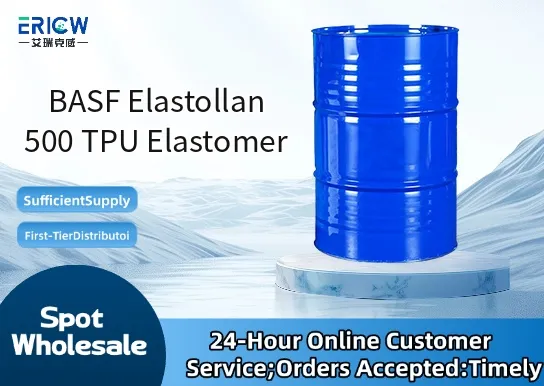
| Chemical Type | Thermoplastic Polyurethane (TPU), polyester-based |
| Product Form | Natural-colored granules |
| Appearance | Opaque, free-flowing cylindrical pellets |
| Primary Applications | Extruded profiles, molded parts, roller covers, industrial tubing |
| Key Features | High abrasion resistance, excellent mechanical resilience, good chemical resistance |
| Processing Temperature Range | 190–220 °C (recommended melt temperature) |
| Density (ISO 1183) | Approx. 1.20 g/cm³ |
| Hardness (Shore A, ISO 868) | Approx. 95 A |
Q1: What are the key processing methods suitable for Elastollan 500?
A: Elastollan 500 is a thermoplastic polyurethane (TPU) elastomer designed for melt-processing techniques including injection molding, extrusion, and blow molding. Its balanced melt viscosity and thermal stability support consistent processing across standard equipment, with recommended drying prior to processing to maintain optimal mechanical performance.
Q2: How does Elastollan 500 compare to other TPU grades in terms of hardness and elasticity?
A: Elastollan 500 is formulated as a medium-hardness TPU, offering a favorable balance between rigidity and elastic recovery. It delivers higher tensile strength and better abrasion resistance than softer TPU grades, while maintaining greater flexibility and impact resilience compared to rigid thermoplastics such as rigid PVC or certain polycarbonates.
Q3: Is Elastollan 500 suitable for applications requiring good low-temperature flexibility?
A: Yes — Elastollan 500 retains useful elasticity and impact resistance at sub-zero temperatures, making it appropriate for outdoor, automotive, and industrial components exposed to cold environments. Performance in extreme cold depends on part geometry and stress conditions, and real-world validation under intended service conditions is recommended.
Q4: Can Elastollan 500 be overmolded onto other thermoplastics?
A: Elastollan 500 is commonly used in two-shot or multi-material injection molding processes, especially over substrates like PP, ABS, PC, and PA. Adhesion quality depends on substrate surface preparation, mold temperature, and process parameters; bonding agents or mechanical anchoring features may be employed to enhance interfacial strength where required.
Contact With Us:
E-mail: wangxingqiang@ericwchem.com
Have a Questions? Call Us:
Add:
Building A1, Jiete Industrial Park, Huangpu District, Guangzhou City, Guangdong Province, China