English
 Español
 tiếng việt
 русский
Excellent abrasion resistance for extended service life in demanding mechanical environments.
High tensile strength and elongation at break, enabling robust performance under dynamic loading.
Good low-temperature flexibility down to –40 °C without significant loss of elasticity.
Outstanding processability via extrusion, injection molding, and calendering with minimal thermal degradation.
Hydrolysis-resistant formulation suitable for humid or wet-condition applications.
Industrial hoses and pneumatic tubing requiring high flex fatigue resistance.
Automotive interior trim components including gear knobs, steering wheel overlays, and soft-touch surfaces.
Conveyor belts and scraper blades in material handling systems.
Footwear midsoles and outsoles demanding rebound resilience and wear durability.
Cable jacketing and protective sheathing for flexible electrical and data cables.
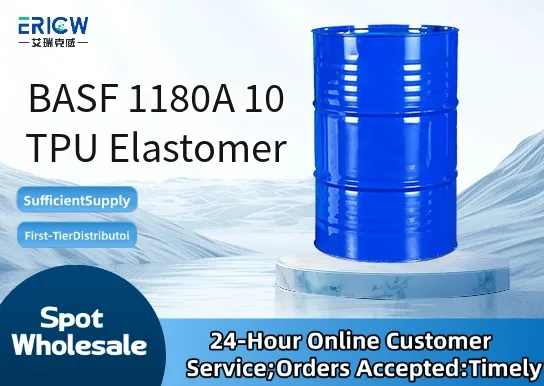
| Chemical Type | Thermoplastic Polyurethane (TPU), Polyester-based |
| Product Form | Pellets |
| Appearance | Off-white to light beige, free-flowing granules |
| Density (g/cm³) | 1.18–1.20 (ASTM D792) |
| Melt Flow Index (g/10 min, 230 °C/2.16 kg) | 10–12 |
| Hardness (Shore A) | 80–85 |
| Primary Applications | Extrusion, injection molding, calendering |
| Key Features | Abrasion resistance, flexibility, hydrolytic stability, melt processability |
Q1: What is the primary application domain for BASF 1180A 10 TPU Elastomer?
A: BASF 1180A 10 is a thermoplastic polyurethane elastomer specifically engineered for demanding extrusion and injection molding applications, particularly in automotive interior components, technical hoses, and flexible industrial profiles requiring excellent melt stability and surface aesthetics.
Q2: How does BASF 1180A 10 differ from standard TPU grades in terms of processing behavior?
A: It features enhanced thermal stability and reduced melt viscosity compared to conventional aromatic TPUs, enabling smoother extrusion at lower shear stress and improved dimensional consistency during high-speed molding—especially beneficial for thin-walled or complex geometries.
Q3: Is BASF 1180A 10 suitable for applications requiring resistance to hydrolysis or elevated temperatures?
A: As an aromatic TPU, it offers good mechanical performance at elevated service temperatures but has limited inherent hydrolytic stability. For long-term exposure to humid or hot/wet environments, stabilization additives or alternative aliphatic TPU systems are typically recommended.
Q4: Can BASF 1180A 10 be blended with other polymers to modify performance?
A: Yes—it demonstrates reasonable compatibility with certain engineering thermoplastics such as polyesters and polycarbonates when used in controlled blends, though phase separation may occur without compatibilizers. Compatibility testing under actual processing conditions is strongly advised.
Contact With Us:
E-mail: wangxingqiang@ericwchem.com
Have a Questions? Call Us:
Add:
Building A1, Jiete Industrial Park, Huangpu District, Guangzhou City, Guangdong Province, China