English
 Español
 tiếng việt
 русский
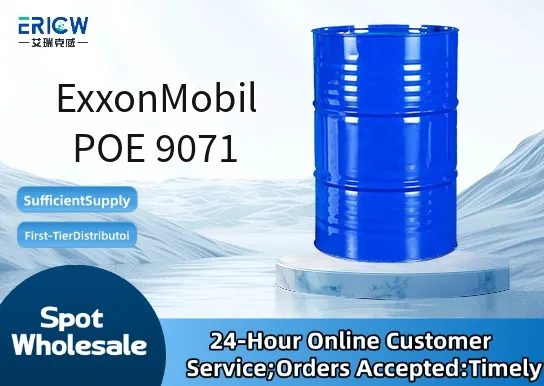
Highly stable polyolester (POE) base fluid engineered for extended service life in demanding refrigeration systems.
Excellent miscibility with HFC, HFO, and next-generation low-GWP refrigerants including R-32, R-1234yf, and R-513A.
Superior thermal and oxidative stability under high-temperature compressor operation.
Low volatility and minimal acid formation, reducing risk of system degradation and copper corrosion.
Consistent viscosity performance across wide operating temperature ranges, supporting reliable lubrication during start-up and steady-state operation.
Hermetic and semi-hermetic compressors in commercial refrigeration units.
Scroll and screw compressors used in chillers and heat pumps.
Lubrication for CO₂ (R-744) transcritical booster systems.
Mobile air conditioning systems transitioning to low-global-warming-potential (GWP) refrigerants.
Industrial refrigeration plants operating with zeotropic or near-azeotropic blends.
| Chemical Type | Polyolester (POE) synthetic lubricant |
| Product Form | Clear, amber liquid |
| Appearance | Homogeneous, transparent, free from sediment |
| Primary Applications | Refrigeration compressor lubrication for HFC/HFO/CO₂ systems |
| Key Features | High thermal stability, low pour point, excellent refrigerant miscibility |
| Benefits | Extended oil life, reduced maintenance, enhanced system reliability |
| Viscosity Grade (ISO VG) | 71 |
| Base Fluid Technology | Diester-modified polyolester |
Q1: What is ExxonMobil POE 9071 and what makes it distinct from conventional plasticizers?
A: ExxonMobil POE 9071 is a polyolester-based processing aid and internal lubricant designed for thermoplastic polymers. Unlike traditional phthalate or adipate plasticizers, it offers enhanced thermal stability, low volatility, and improved compatibility with high-temperature resins such as polypropylene, polyethylene, and engineering thermoplastics.
Q2: Is POE 9071 suitable for use in food-contact or medical-grade polymer applications?
A: POE 9071 is formulated to meet general requirements for indirect food-contact applications under FDA 21 CFR §178.3740 (lubricants) and EU Regulation (EC) No 1935/2004 for plastics. However, final compliance depends on the full formulation, processing conditions, and end-use exposure—users must validate suitability through their own regulatory assessment and testing.
Q3: How does POE 9071 affect melt flow and surface finish in extruded or injection-molded parts?
A: POE 9071 typically reduces melt viscosity and improves polymer flow during processing, leading to lower energy consumption and more consistent part filling. It also contributes to smoother surface appearance and reduced die build-up in continuous operations, particularly in filled or pigmented compounds.
Q4: Can POE 9071 be used alongside other additives such as antioxidants, UV stabilizers, or nucleating agents?
A: Yes—POE 9071 demonstrates good compatibility with common additive packages, including hindered phenols, phosphites, HALS stabilizers, and organic nucleating agents. As with any multi-additive system, compatibility and performance should be verified in the target resin matrix under actual processing conditions.
Contact With Us:
E-mail: wangxingqiang@ericwchem.com
Have a Questions? Call Us:
Add:
Building A1, Jiete Industrial Park, Huangpu District, Guangzhou City, Guangdong Province, China