English
 Español
 tiếng việt
 русский
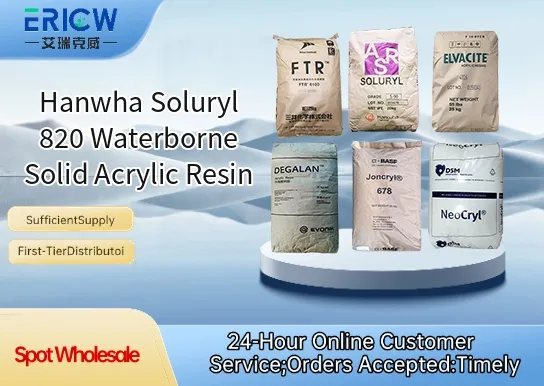
High-solids, waterborne acrylic dispersion offering excellent film formation without coalescing agents.
Outstanding weather resistance and UV stability for long-term outdoor performance.
Low VOC content (< 50 g/L), compliant with stringent global environmental regulations.
Superior hardness and scratch resistance in cured films, enhancing durability.
Good compatibility with common waterborne crosslinkers (e.g., melamine and aziridine types).
Architectural exterior wall coatings requiring high gloss retention and color stability.
Industrial maintenance coatings for metal substrates in mild to moderate corrosion environments.
Waterborne wood finishes demanding clarity, hardness, and low odor.
Plastic coatings for ABS and PC substrates where adhesion and flexibility balance is critical.
High-performance clearcoats for decorative and protective topcoats in OEM-adjacent applications.
| Chemical Type | Acrylic copolymer dispersion |
| Product Form | White to slightly yellow opaque liquid |
| Appearance | Homogeneous aqueous dispersion |
| Solids Content (wt%) | 48 ± 1% |
| pH | 7.5 – 8.5 |
| Viscosity (mPa·s, Brookfield RVT, #2 spindle, 20 rpm) | 150 – 300 |
| Density (g/cm³ at 25°C) | 1.02 – 1.04 |
| VOC Content | < 50 g/L (ASTM D6886) |
Q1: What are the primary application areas for Hanwha Soluryl 820?
A: Hanwha Soluryl 820 is widely used in waterborne industrial coatings, including general-purpose protective coatings, architectural finishes, and low-VOC maintenance paints where good film formation, gloss retention, and alkali resistance are required.
Q2: How does Soluryl 820 differ from conventional emulsion acrylic resins?
A: Unlike typical acrylic emulsions, Soluryl 820 is a waterborne solid acrylic dispersion with higher solids content and lower water demand, enabling improved green strength, faster drying behavior, and enhanced compatibility with hydrophobic additives and crosslinkers.
Q3: Can Soluryl 820 be used in high-gloss or metallic effect systems?
A: Yes — its excellent clarity, low haze, and balanced rheology support high-gloss topcoats and metallic basecoats, particularly when formulated with appropriate dispersants and flow agents to ensure pigment orientation and surface uniformity.
Q4: Is Soluryl 820 compatible with common coalescing agents and crosslinkers?
A: It demonstrates broad compatibility with standard coalescents such as Texanol® and Dowanol™ series, and can be effectively crosslinked with melamine-formaldehyde resins, aziridines, or polyisocyanates—formulation optimization is recommended to balance cure speed and storage stability.
Q5: What handling or storage conditions are recommended for optimal performance?
A: Store in tightly sealed containers at temperatures between 5°C and 30°C, avoiding freezing and prolonged exposure to direct sunlight. Prior to use, gentle mechanical stirring is advised to ensure homogeneity without introducing excessive air.
Contact With Us:
E-mail: wangxingqiang@ericwchem.com
Have a Questions? Call Us:
Add:
Building A1, Jiete Industrial Park, Huangpu District, Guangzhou City, Guangdong Province, China