English
 Español
 tiếng việt
 русский
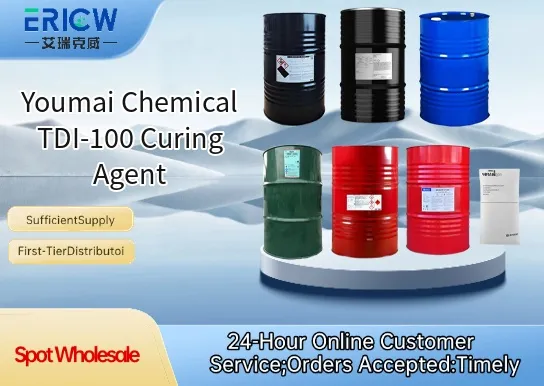
High reactivity with polyols for rapid gelation and short demold times.
Excellent compatibility with aromatic and aliphatic polyether/polyester polyols.
Consistent batch-to-batch performance ensured by strict ISO 9001-controlled manufacturing.
Low volatility and reduced monomer residue, supporting safer handling and lower VOC emissions.
Enhanced thermal and mechanical stability in cured elastomer and foam matrices.
Flexible and semi-rigid polyurethane foams for automotive seating and interior trim.
Cast elastomers used in industrial rollers, mining screens, and hydraulic seals.
Coatings and adhesives requiring fast cure, high abrasion resistance, and chemical durability.
Rigid insulation foams for refrigeration units and building envelope systems.
| Chemical Type | Toluene diisocyanate (TDI)-based prepolymers, predominantly 2,4-TDI isomer |
| Product Form | Liquid |
| Appearance | Pale yellow to amber transparent liquid |
| Functionality | Bifunctional curing agent (NCO-reactive) |
| NCO Content (wt%) | 12.5–13.5% |
| Viscosity at 25°C (mPa·s) | 180–250 |
| Specific Gravity (25°C) | 1.18–1.22 |
| Storage Stability | 6 months in unopened original container at <25°C, dry conditions |
Q1: What is the primary chemical nature of TDI-100 Curing Agent?
A: TDI-100 is an aromatic polyisocyanate-based curing agent derived from toluene diisocyanate (TDI), formulated as a reactive liquid component designed to crosslink hydroxyl-functional resins—particularly polyesters and acrylics—in two-component coating and adhesive systems.
Q2: How does TDI-100 differ from aliphatic isocyanate curing agents?
A: Unlike aliphatic alternatives, TDI-100 offers higher reactivity at ambient temperatures and delivers excellent hardness and chemical resistance in the final film. However, it is not recommended for exterior applications requiring long-term UV stability due to its aromatic structure, which may lead to yellowing under prolonged light exposure.
Q3: What safety precautions should be observed during handling?
A: As with all isocyanate-containing products, TDI-100 requires strict engineering controls—including local exhaust ventilation—and appropriate personal protective equipment (PPE) such as nitrile gloves, chemical-resistant goggles, and respiratory protection when aerosol or vapor exposure is possible. Avoid skin contact and inhalation of vapors or mists.
Q4: Can TDI-100 be used in high-solids or low-VOC formulations?
A: Yes—TDI-100 is compatible with high-solids resin systems and can support VOC-reduced formulations when paired with low-solvent or solvent-free hydroxyl components. Its reactivity profile allows for efficient cure at reduced solvent levels, though formulation optimization is required to balance pot life and film development.
Q5: What is the typical shelf life and recommended storage condition?
A: When stored unopened in original sealed containers at temperatures between 15°C and 25°C, away from moisture and direct sunlight, TDI-100 maintains stability for up to 12 months. Prolonged exposure to humidity or elevated temperatures may cause premature dimerization or gelation.
Contact With Us:
E-mail: wangxingqiang@ericwchem.com
Have a Questions? Call Us:
Add:
Building A1, Jiete Industrial Park, Huangpu District, Guangzhou City, Guangdong Province, China