English
 Español
 tiếng việt
 русский
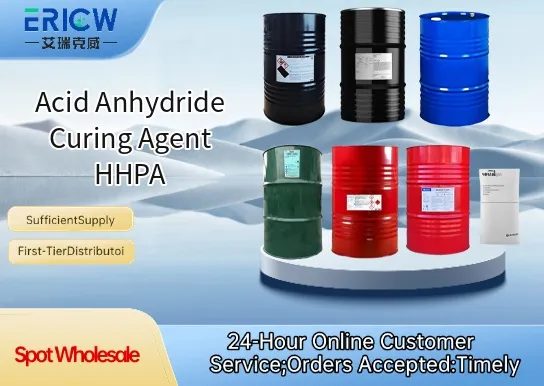
High purity hexahydrophthalic anhydride (HHPA) with low volatile content for consistent epoxy curing performance.
Excellent thermal stability and low exotherm profile, enabling controlled cure cycles in thick-section composites.
Low viscosity and good miscibility with standard bisphenol-A and novolac epoxy resins.
Superior electrical insulation properties after full cure, meeting IEC 60273 requirements.
Hydrolytically stable structure, offering extended pot life under ambient humidity conditions.
Electrical encapsulation of high-voltage transformers and bushings.
Insulating castings for dry-type power transformers and reactors.
Matrix resin for filament-wound composite pressure vessels and structural components.
Curing agent in aerospace-grade potting compounds requiring low outgassing and high Tg.
High-performance laminates for printed circuit board (PCB) substrates demanding dimensional stability.
| Chemical Type | Hexahydrophthalic anhydride (HHPA), saturated cyclic acid anhydride |
| Product Form | Crystalline solid at room temperature |
| Appearance | White to off-white crystalline powder or granules |
| Melting Point | 135–139 °C (determined by ASTM D2117) |
| Acid Value | 740–760 mg KOH/g (ASTM D4662) |
| Volatility (Loss on Heating at 150°C, 2h) | ≤ 0.3 wt% |
| Moisture Content | ≤ 0.1 wt% (Karl Fischer titration) |
| Key Features | Low color, high thermal resistance, low toxicity profile vs. aromatic anhydrides |
Q1: What is HHPA and how does it function as a curing agent?
A: Hexahydrophthalic anhydride (HHPA) is a saturated cyclic acid anhydride widely used as a reactive curing agent for epoxy resins. It reacts with epoxy groups under thermal activation to form stable ester linkages, delivering excellent electrical insulation, low moisture absorption, and enhanced thermal stability in the cured network.
Q2: What are the typical processing conditions required for HHPA-cured systems?
A: HHPA generally requires elevated temperature curing—commonly initiated around 100–120 °C and fully developed between 140–180 °C. A post-cure step is often recommended to maximize crosslink density and performance properties. Accelerators such as tertiary amines or imidazoles may be used to moderate reactivity and improve pot life.
Q3: How does HHPA compare to other anhydride curing agents in terms of handling and safety?
A: As a saturated anhydride, HHPA exhibits lower volatility and reduced skin sensitization potential compared to unsaturated counterparts like phthalic anhydride. It remains a mild irritant, however, and appropriate industrial hygiene practices—including gloves, eye protection, and adequate ventilation—are essential during handling.
Q4: Is HHPA suitable for applications requiring high electrical performance and long-term reliability?
A: Yes—HHPA-cured epoxy systems are widely specified in high-voltage insulation, encapsulation of power electronics, and aerospace composites due to their low dielectric loss, high volume resistivity, and resistance to tracking and partial discharge under humid or contaminated conditions.
Q5: What resin compatibility considerations should be taken into account when using HHPA?
A: HHPA performs best with standard bisphenol-A and bisphenol-F epoxy resins. Its reactivity and final properties can be influenced by resin molecular weight and functionality; formulations with multifunctional epoxies or novolacs may require adjusted stoichiometry or accelerator levels to ensure complete cure and optimal mechanical integrity.
Contact With Us:
E-mail: wangxingqiang@ericwchem.com
Have a Questions? Call Us:
Add:
Building A1, Jiete Industrial Park, Huangpu District, Guangzhou City, Guangdong Province, China