English
 Español
 tiếng việt
 русский
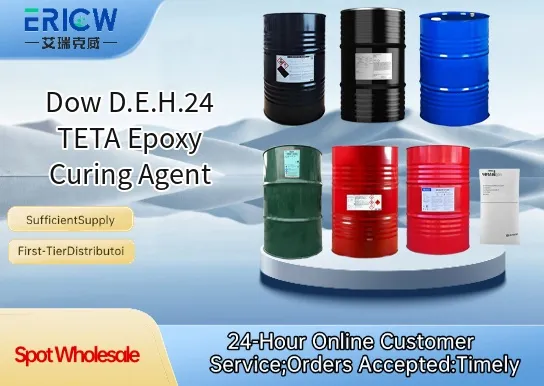
Triethylenetetramine (TETA)-based aliphatic amine curing agent offering rapid room-temperature cure kinetics.
Enables high crosslink density for excellent chemical resistance and thermal stability in cured epoxy systems.
Provides good flexibility and impact resistance without compromising hardness or adhesion.
Compatible with standard bisphenol-A and bisphenol-F epoxy resins across a broad formulation range.
Low viscosity facilitates easy handling, metering, and thorough mixing with epoxy components.
Industrial flooring and protective coatings for concrete substrates.
Electrical encapsulants and potting compounds requiring fast turnaround and high dielectric strength.
Adhesives and structural bonding agents in automotive and aerospace assembly.
Mold-making and tooling compounds where dimensional stability and low exotherm are critical.
Repair mortars and grouts for infrastructure maintenance and marine environments.
| Chemical Type | Aliphatic polyamine (triethylenetetramine derivative) |
| Product Form | Liquid |
| Appearance | Clear, pale yellow to amber liquid |
| Primary Applications | Epoxy coatings, adhesives, potting compounds, and repair materials |
| Key Features | Rapid ambient cure, high reactivity, low viscosity, good compatibility |
| Benefits | Shorter cycle times, strong adhesion, corrosion resistance, ease of processing |
| Storage Stability | Stable under dry, cool conditions (15–25°C); protect from moisture and CO₂ |
| Handling Precautions | Use with adequate ventilation; skin/eye protection recommended per SDS |
Q1: What is the primary chemical nature of D.E.H.24 TETA?
A: D.E.H.24 TETA is a triethylenetetramine (TETA)-based aliphatic amine curing agent, formulated to provide rapid reactivity with epoxy resins while maintaining good handling properties and compatibility in solvent-free or low-VOC systems.
Q2: How does D.E.H.24 differ from standard TETA in terms of handling and performance?
A: D.E.H.24 is a modified TETA derivative designed to reduce volatility and skin sensitization potential compared to unmodified TETA, while retaining high reactivity and delivering improved pot life control and reduced exotherm in thick-section castings or adhesives.
Q3: What types of epoxy resins is D.E.H.24 typically compatible with?
A: D.E.H.24 is broadly compatible with standard liquid and solid bisphenol-A and bisphenol-F epoxy resins, as well as novolac epoxies. It is especially suited for formulations requiring fast ambient-cure performance, such as industrial coatings, electrical encapsulants, and structural adhesives.
Q4: What are key formulation considerations when using D.E.H.24?
A: Formulators should account for its amine hydrogen equivalent weight when calculating stoichiometry, monitor ambient humidity during cure (as aliphatic amines can be sensitive to CO₂ and moisture), and consider post-cure conditions to optimize final crosslink density and thermal resistance.
Q5: Is D.E.H.24 suitable for food-contact or potable water applications?
A: D.E.H.24 is not pre-qualified for direct food-contact or potable water applications. Its use in such regulatory-sensitive end uses requires full formulation evaluation, including migration testing and compliance verification against applicable regional regulations by the end-user or compounder.
Contact With Us:
E-mail: wangxingqiang@ericwchem.com
Have a Questions? Call Us:
Add:
Building A1, Jiete Industrial Park, Huangpu District, Guangzhou City, Guangdong Province, China