English
 Español
 tiếng việt
 русский
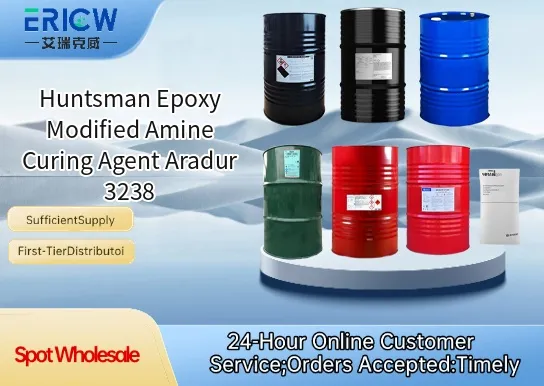
Low-viscosity liquid enabling excellent mixing and processing with standard epoxy resins.
Extended pot life at ambient temperature, supporting longer working times for large-scale applications.
Fast cure kinetics at elevated temperatures (e.g., 80–120 °C), delivering high glass transition temperature (Tg) in final networks.
Improved chemical resistance and mechanical performance compared to conventional aliphatic amines.
Reduced volatility and amine odor, contributing to safer handling and improved workplace hygiene.
High-performance composite matrices for aerospace and wind turbine blade manufacturing.
Structural adhesives requiring thermal stability and long-term durability.
Electrical encapsulation and potting compounds for power electronics and EV components.
Industrial flooring and heavy-duty protective coatings in chemical processing facilities.
Tooling and mold-making resins demanding dimensional stability and low exotherm.
| Chemical Type | Epoxy-modified aliphatic amine |
| Product Form | Liquid |
| Appearance | Pale yellow to amber clear liquid |
| Density (25 °C) | Approx. 0.96–0.99 g/cm³ |
| Viscosity (25 °C) | Approx. 200–400 mPa·s |
| Amine Value | 240–270 mg KOH/g |
| Reactive Hydrogen Equivalent Weight (RHEW) | Approx. 110–125 g/eq |
| Primary Applications | High-performance structural composites, adhesives, encapsulants, and industrial coatings |
Q1: What is the primary function of Aradur 3238 in epoxy systems?
A: Aradur 3238 is an epoxy-modified amine curing agent designed to provide enhanced compatibility, reduced volatility, and improved handling characteristics compared to conventional aliphatic amines—enabling more robust gel times and better film formation in solvent-based and high-solids epoxy coatings and adhesives.
Q2: Is Aradur 3238 suitable for ambient-cure applications?
A: Yes, Aradur 3238 is formulated for ambient-temperature cure, offering good reactivity at room temperature while maintaining acceptable pot life—making it well-suited for industrial maintenance coatings, flooring systems, and structural bonding where forced curing is not feasible.
Q3: How does Aradur 3238 compare to standard DETA or TETA in terms of odor and skin sensitization risk?
A: As an epoxy-modified amine, Aradur 3238 exhibits significantly lower volatility and reduced amine odor versus unmodified aliphatic amines like DETA or TETA. Its modified structure also contributes to lower dermal sensitization potential, supporting safer handling in production environments—though appropriate PPE remains essential.
Q4: Can Aradur 3238 be used in high-performance corrosion protection coatings?
A: Yes—it is commonly incorporated into high-build epoxy primers and mid-coats for marine, offshore, and industrial infrastructure due to its ability to support excellent intercoat adhesion, chemical resistance, and cohesive strength when paired with appropriate epoxy resins.
Contact With Us:
E-mail: wangxingqiang@ericwchem.com
Have a Questions? Call Us:
Add:
Building A1, Jiete Industrial Park, Huangpu District, Guangzhou City, Guangdong Province, China