English
 Español
 tiếng việt
 русский
Excellent soft-touch feel with balanced elasticity and surface tack control.
Good processability on standard injection molding and extrusion equipment.
Enhanced compatibility with polypropylene (PP) and polyethylene (PE) substrates.
Low extractables profile suitable for non-food-contact industrial applications.
UV-stabilized formulation offering improved resistance to outdoor weathering.
Automotive interior trim components including instrument panel skins and door armrests.
Consumer electronics housings and overmolded grips for power tools and appliances.
Industrial handles, seals, and gasketing for durable equipment enclosures.
Medical device non-critical components such as ergonomic casings and actuator covers.
Household appliance control knobs and flexible interface elements.
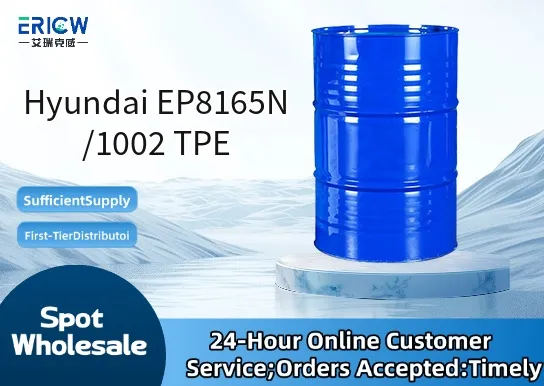
| Chemical Type | Thermoplastic Elastomer (TPE), SEBS-based |
| Product Form | Pellets |
| Appearance | Off-white, uniform cylindrical pellets |
| Hardness (Shore A) | 65 ± 3 |
| Melt Flow Rate (230°C/5 kg) | 12–16 g/10 min |
| Density | 0.92–0.94 g/cm³ |
| Primary Applications | Overmolding, soft-touch finishing, flexible functional parts |
| Key Features | PP/PE adhesion, low compression set, good thermal stability |
Q1: What is the primary application domain for Hyundai EP8165N/1002 TPE?
A: Hyundai EP8165N/1002 TPE is a thermoplastic elastomer formulated primarily for soft-touch overmolding and functional grip applications—especially in automotive interior components, consumer electronics housings, and medical device handles where resilience, tactile comfort, and adhesion to rigid substrates like PP or ABS are required.
Q2: Is EP8165N/1002 compatible with common injection molding equipment and processing conditions?
A: Yes—it is designed for standard injection molding and two-shot molding processes. It exhibits good thermal stability and melt flow behavior within typical TPE processing windows, and does not require specialized drying beyond standard desiccant drying at 60–70 °C for 2–4 hours prior to processing.
Q3: How does EP8165N/1002 achieve adhesion to polypropylene (PP) substrates?
A: The grade incorporates a tailored compatibilizer system that promotes interfacial bonding with PP during overmolding. Adhesion performance is optimized when mold temperature, melt temperature, and injection speed are balanced to ensure sufficient melt interdiffusion without degradation—no additional primers or surface treatments are typically needed.
Q4: Can this TPE be used in applications requiring regulatory compliance for food contact or skin contact?
A: While EP8165N/1002 is based on non-toxic, FDA-acceptable raw materials and is commonly selected for skin-contact applications such as grips and wearable interfaces, formal regulatory clearance depends on final formulation, processing conditions, and end-use requirements. Customers should conduct full regulatory validation for their specific application and jurisdiction.
Q5: What is the typical dosage range when using EP8165N/1002 as a processing aid or modifier in PP blends?
A: When blended into PP systems to enhance impact resistance or flexibility, EP8165N/1002 is generally used at low concentrations—typically ranging from 0.1% to 2% by weight—depending on the desired balance of toughness, elongation, and stiffness in the final compound.
Contact With Us:
E-mail: wangxingqiang@ericwchem.com
Have a Questions? Call Us:
Add:
Building A1, Jiete Industrial Park, Huangpu District, Guangzhou City, Guangdong Province, China