English
 Español
 tiếng việt
 русский
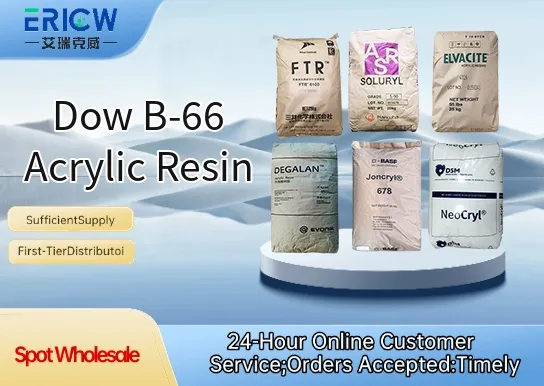
High gloss and excellent clarity for premium aesthetic finishes.
Outstanding UV resistance and long-term color retention in outdoor exposure.
Good compatibility with common crosslinkers including melamine and polyisocyanates.
Low VOC formulation suitable for compliance with stringent environmental regulations.
Excellent flow and leveling properties for smooth, defect-free film formation.
Automotive OEM clearcoats and basecoats.
Industrial maintenance coatings for metal substrates.
Architectural high-performance exterior coatings.
Plastic coatings requiring adhesion and flexibility.
Refinish coatings for automotive and heavy-duty equipment.
| Chemical Type | Thermosetting acrylic copolymer |
| Product Form | Liquid resin solution |
| Appearance | Clear, pale yellow liquid |
| Solvent System | Standard aromatic/ester blend |
| Non-Volatile Content (wt%) | 50–55% |
| Acid Value (mg KOH/g) | 8–12 |
| Weight-Average Molecular Weight (Mw) | ~8,000–12,000 Da |
| Viscosity (25°C, mPa·s) | 1,200–1,800 |
Q1: What is the primary function of Dow B-66 Acrylic Resin in coating and ink formulations?
A: Dow B-66 is a water-soluble acrylic resin designed primarily as a rheology modifier and film-forming aid. It enhances viscosity control, improves pigment suspension stability, and contributes to gloss, leveling, and substrate adhesion in waterborne systems.
Q2: Is Dow B-66 compatible with common water-based polymer dispersions and additives?
A: Yes, Dow B-66 exhibits broad compatibility with acrylic emulsions, vinyl acetate copolymers, polyurethane dispersions, and many common surfactants, defoamers, and coalescing agents—provided pH is maintained within the recommended range (typically 7–9) to preserve colloidal stability.
Q3: How should Dow B-66 be incorporated into a formulation to ensure optimal performance?
A: It is recommended to add Dow B-66 during the let-down stage, after initial dispersion of pigments and fillers. Dilution with deionized water prior to addition helps prevent localized gelation. Gentle agitation is sufficient—high-shear mixing is not required and may degrade performance.
Q4: Does Dow B-66 contribute to final film properties such as hardness or flexibility?
A: While not a primary film former, Dow B-66 can influence film integrity by promoting coalescence and interparticle fusion. It generally supports balanced film development—enhancing early hardness without significantly compromising flexibility in properly formulated systems.
Contact With Us:
E-mail: wangxingqiang@ericwchem.com
Have a Questions? Call Us:
Add:
Building A1, Jiete Industrial Park, Huangpu District, Guangzhou City, Guangdong Province, China