English
 Español
 tiếng việt
 русский
High reactivity with hydroxyl-functional resins, enabling efficient crosslinking at moderate cure temperatures.
Excellent compatibility with acrylic, polyester, and alkyd resins for broad formulation flexibility.
Low formaldehyde emission profile, supporting compliance with stringent environmental and occupational health standards.
Good storage stability in solvent-based systems when properly formulated and handled.
Delivers superior hardness, chemical resistance, and gloss retention in thermoset coatings.
Automotive OEM and refinish topcoats requiring high durability and appearance performance.
Industrial coil and can coatings where rapid cure and corrosion resistance are critical.
General-purpose appliance and metal furniture coatings.
High-performance wood finishes for furniture and cabinetry.
Electrical insulation varnishes for motor and transformer applications.
| Chemical Type | Methylated melamine-formaldehyde resin |
| Product Form | Liquid |
| Appearance | Clear, pale yellow to amber liquid |
| Solvent Content | Approx. 70–75% (in n-butanol) |
| Non-Volatile Content | 25–30% (by weight, ASTM D1259) |
| Viscosity (25°C) | 20–40 mPa·s (ASTM D1084) |
| pH (10% solution in water) | 7.5–9.0 |
| Primary Applications | Crosslinker for hydroxyl-functional resins in thermosetting coatings |
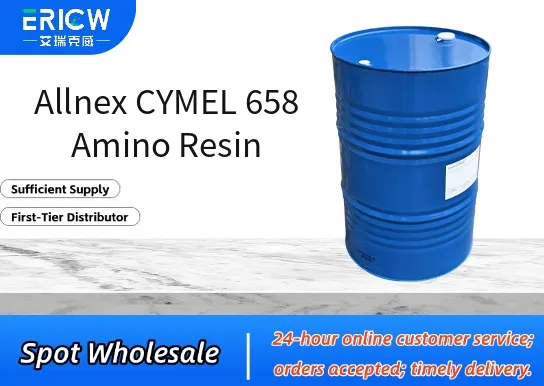
Q1: What is the primary function of CYMEL 658 in coating formulations?
A: CYMEL 658 acts as a highly reactive melamine-formaldehyde crosslinker, designed to enhance hardness, chemical resistance, and thermal stability in thermosetting coatings—particularly in high-performance industrial and automotive topcoats.
Q2: How does CYMEL 658 differ from other melamine resins in terms of reactivity and cure profile?
A: CYMEL 658 features a partially methylated, low-viscosity structure that offers balanced reactivity—enabling efficient curing at moderate temperatures (typically 120–160 °C) without excessive volatility or premature gelation, making it suitable for both coil and general metal coatings.
Q3: Is CYMEL 658 compatible with hydroxyl-functional acrylics and polyesters?
A: Yes—CYMEL 658 is specifically formulated for excellent compatibility and reactivity with hydroxyl-terminated resins, including acrylics, polyesters, and alkyds, and is commonly used in solventborne and high-solids coating systems.
Q4: What are typical handling and storage recommendations for CYMEL 658?
A: Store in tightly sealed containers in a cool, dry, well-ventilated area away from strong oxidizers and direct sunlight. Avoid prolonged exposure to moisture or high humidity, as amino resins may undergo gradual self-condensation over time under suboptimal conditions.
Q5: Can CYMEL 658 be used in low-VOC or high-solids formulations?
A: Yes—its low viscosity and high solids content support formulation flexibility in reduced-solvent and high-solids systems, helping formulators meet evolving environmental and regulatory expectations without compromising film performance.
Contact With Us:
E-mail: wangxingqiang@ericwchem.com
Have a Questions? Call Us:
Add:
Building A1, Jiete Industrial Park, Huangpu District, Guangzhou City, Guangdong Province, China