English
 Español
 tiếng việt
 русский
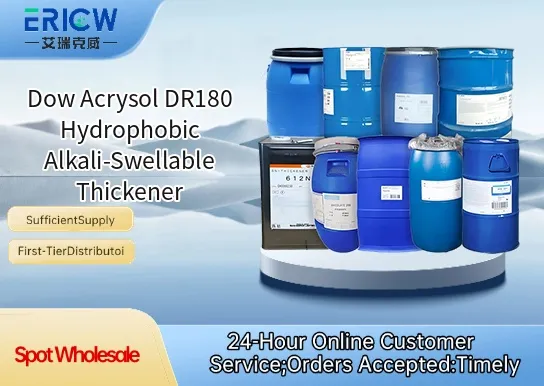
Delivers high-shear viscosity stability in waterborne coatings and inks.
Provides excellent sag resistance and leveling balance in architectural and industrial paints.
Offers robust rheology control under alkaline conditions without requiring high pH adjustment.
Enhances spatter resistance and brush drag performance in latex-based formulations.
Compatible with anionic surfactants and common co-thickeners such as HEC and associative HEUR thickeners.
Interior and exterior architectural flat and low-sheen latex paints.
Industrial maintenance coatings for metal and concrete substrates.
Waterborne wood stains and clear finishes.
Low-VOC and zero-VOC decorative coatings.
Exterior masonry and stucco coatings.
| Chemical Type | Hydrophobic alkali-swellable emulsion (HASE) |
| Product Form | Aqueous dispersion |
| Appearance | Off-white to light yellow, opaque liquid |
| pH (as received) | 3.0–4.5 |
| Active Content (wt%) | 30.0–32.0% |
| Viscosity (Brookfield, spindle #3, 20 rpm, 25°C) | 500–2,000 cP |
| Primary Applications | Rheology modifier for waterborne architectural and industrial coatings |
| Key Features | Hydrophobic modification, alkali-activated thickening, shear-thinning behavior |
Q1: How does DR180 differ from conventional alkali-swellable thickeners?
A: DR180 is a hydrophobic alkali-swellable emulsion polymer that provides enhanced resistance to water sensitivity and improved rheological performance in high-electrolyte or low-pH systems compared to non-hydrophobically modified ASAs. Its hydrophobic character contributes to better film integrity and reduced water leaching in dried films.
Q2: What types of formulations is DR180 typically used in?
A: DR180 is commonly employed in architectural coatings (e.g., interior and exterior paints), industrial maintenance coatings, and some specialty waterborne adhesives where robust viscosity build, good sag resistance, and tolerance to co-solvents or surfactants are required.
Q3: How should DR180 be incorporated into a formulation?
A: DR180 is generally added during the let-down stage, after neutralization of other acid-functional components. It should be diluted with water or a compatible solvent prior to addition and mixed under moderate shear to ensure uniform dispersion. Avoid direct addition to highly acidic or unneutralized systems to prevent premature swelling or instability.
Q4: Does DR180 require neutralization before thickening takes effect?
A: Yes — like all alkali-swellable thickeners, DR180 requires pH adjustment to approximately 8.0–9.5 (typically using ammonia, AMP-95™, or sodium hydroxide) to ionize carboxylic groups and enable full viscosity development. Thinning may occur if pH drops significantly during storage or application.
Contact With Us:
E-mail: wangxingqiang@ericwchem.com
Have a Questions? Call Us:
Add:
Building A1, Jiete Industrial Park, Huangpu District, Guangzhou City, Guangdong Province, China