English
 Español
 tiếng việt
 русский
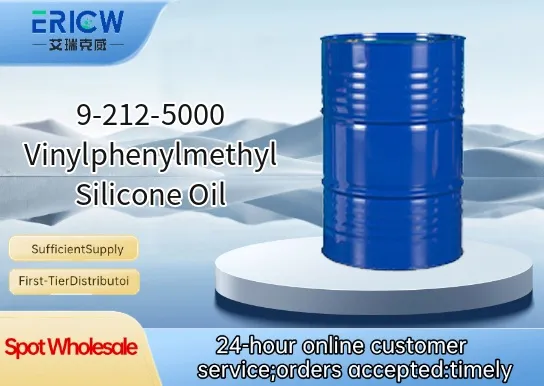
High thermal stability with continuous service capability up to 200 °C.
Excellent compatibility with organic resins, vinyl polymers, and phenolic systems.
Low volatility and minimal outgassing under vacuum or elevated temperature conditions.
Reactive vinyl groups enable covalent bonding in crosslinking formulations.
Phenyl substitution enhances UV resistance and reduces refractive index for optical applications.
Heat-resistant release agents for high-temperature composite molding.
Functional additive in silicone-modified acrylic and epoxy coatings.
Base fluid for specialty optical gels and LED encapsulants.
Viscosity modifier and surface conditioner in high-performance adhesives.
| Chemical Type | Vinylphenylmethyl silicone fluid (linear) |
| Product Form | Clear, colorless to pale yellow liquid |
| Appearance | Transparent, homogeneous, free of sediment |
| Viscosity (25 °C, cSt) | 5,000 ± 500 |
| Specific Gravity (25 °C) | 0.98–1.02 |
| Vinyl Content (wt%) | 0.15–0.25 |
| Phenyl Content (wt%) | 25–32 |
| Flash Point (COC, °C) | ≥300 |
Q1: What is the primary functional role of 9-212-5000 in formulations?
A: 9-212-5000 serves as a reactive silicone modifier that enhances surface migration, improves substrate wetting, and imparts durable slip and release characteristics—particularly in thermoset resins, coatings, and high-performance elastomers where vinyl and phenyl functionality support covalent integration.
Q2: Is 9-212-5000 compatible with platinum-catalyzed silicone systems?
A: Yes—it is specifically designed for compatibility with hydrosilylation-curable systems. The vinyl groups enable efficient crosslinking with Si–H functionalities, while the phenyl moiety contributes to thermal stability and reduced volatility during processing.
Q3: How does 9-212-5000 differ from standard methylvinyl silicone oils?
A: The incorporation of phenyl groups significantly increases thermal resistance and refractive index, while also improving compatibility with aromatic polymers and reducing surface tension more effectively than purely aliphatic analogues—making it especially suitable for optical adhesives and high-heat-release applications.
Q4: What are typical handling and storage recommendations?
A: Store in tightly sealed containers under inert atmosphere (e.g., nitrogen), away from moisture, strong oxidizers, and direct sunlight. Prolonged exposure to ambient humidity or elevated temperatures may affect viscosity stability over time.
Contact With Us:
E-mail: wangxingqiang@ericwchem.com
Have a Questions? Call Us:
Add:
Building A1, Jiete Industrial Park, Huangpu District, Guangzhou City, Guangdong Province, China