English
 Español
 tiếng việt
 русский
High thermal stability suitable for processing temperatures up to 800°C.
Excellent lightfastness and weather resistance, maintaining color integrity under UV exposure.
Non-toxic composition compliant with global regulatory standards including REACH and RoHS.
Consistent particle size distribution ensuring uniform dispersion in diverse matrices.
Low oil absorption enabling efficient pigment loading and improved rheology in formulations.
Ceramic glazes and frits for tableware and architectural tiles.
High-performance refractory coatings used in kiln furniture and furnace linings.
Coloration of inorganic binders in construction materials such as concrete and stucco.
Heat-resistant plastics for automotive under-hood components.
Specialty glass coloring for technical and decorative applications.
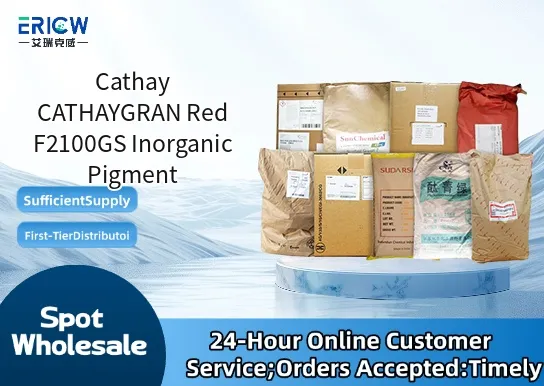
| Chemical Type | Mixed metal oxide (Fe–Cr–Al spinel-based) |
| Product Form | Free-flowing fine powder |
| Appearance | Brilliant red granular powder |
| Primary Applications | Ceramics, refractories, glass, high-temp plastics |
| Key Features | Thermal stability, chemical inertness, non-volatile |
| Benefits | Color consistency, low migration, minimal batch variation |
| pH (5% aqueous suspension) | 6.5 – 7.5 |
| Moisture Content (wt%) | ≤ 0.5% |
Q1: What is the primary chemical composition of Cathay CATHAYGRAN Red F2100GS?
A: Cathay CATHAYGRAN Red F2100GS is an iron oxide-based inorganic pigment, formulated with a stabilized hematite (α-Fe₂O₃) crystal structure. It contains no heavy metals such as lead, cadmium, or chromium(VI), and is designed for high thermal and chemical stability.
Q2: Is this pigment suitable for use in food-contact plastics or packaging applications?
A: Yes — Cathay CATHAYGRAN Red F2100GS is manufactured under strict quality control to meet general requirements for pigments used in food-contact polymers. It complies with global regulatory expectations for non-toxicity and extractable residue limits when incorporated into approved polymer matrices, subject to final formulation validation.
Q3: How does F2100GS perform under high-temperature processing conditions?
A: This pigment exhibits excellent thermal stability, retaining its color integrity and dispersion characteristics during standard polymer processing operations—including extrusion, injection molding, and blow molding—at temperatures up to 280 °C. Its inorganic nature ensures minimal decomposition or gas evolution.
Q4: What is the recommended dispersion method for optimal color development in polyolefins?
A: For best results in polyolefins, pre-dispersion via masterbatch preparation is strongly advised. High-shear compounding at appropriate melt temperature and residence time ensures uniform distribution and maximizes opacity and chroma. Direct addition may require extended mixing to avoid speckling or reduced tinting strength.
Q5: Can F2100GS be used in engineering resins like PBT or PC?
A: Yes — it demonstrates good compatibility and color stability in high-performance engineering thermoplastics, including PBT and polycarbonate, provided processing parameters are optimized to avoid prolonged exposure above 300 °C. Performance should be verified in the target resin system due to potential interactions with flame retardants or stabilizers.
Contact With Us:
E-mail: wangxingqiang@ericwchem.com
Have a Questions? Call Us:
Add:
Building A1, Jiete Industrial Park, Huangpu District, Guangzhou City, Guangdong Province, China