English
 Español
 tiếng việt
 русский
Excellent mechanical strength and dimensional stability after curing.
Good compatibility with standard MEKP initiators and low-profile additives.
Low viscosity for enhanced fiber wet-out and improved mold filling in composite processing.
Consistent batch-to-batch performance ensured by Chang Chun’s stringent quality control.
Optimized reactivity profile for balanced gel time and post-cure development in ambient and elevated temperature applications.
Fiberglass-reinforced plastic (FRP) tanks and chemical storage vessels.
Pultruded profiles including structural rods, gratings, and ladder rails.
Sheet molding compound (SMC) for automotive under-hood components.
Centrifugally cast pipes and ducts for water and wastewater infrastructure.
Marine deck laminates and non-structural boat hull reinforcements.
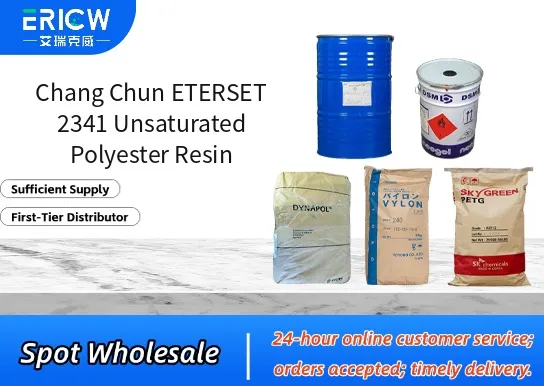
| Chemical Type | Orthophthalic unsaturated polyester resin |
| Product Form | Liquid, ready-to-use |
| Appearance | Clear to pale yellow viscous liquid |
| Viscosity (25°C, mPa·s) | 350–550 |
| Gel Time (with 1.0% MEKP, 25°C, min) | 12–20 |
| Solid Content (% w/w) | 99.5–100.0 |
| Density (25°C, g/cm³) | 1.12–1.16 |
| Primary Applications | FRP, pultrusion, SMC, centrifugal casting |
Q1: What are the primary curing systems compatible with ETERSET 2341?
A: ETERSET 2341 is designed for free-radical polymerization and is typically cured using organic peroxides such as methyl ethyl ketone peroxide (MEKP) or benzoyl peroxide (BPO), often in combination with accelerators like cobalt naphthenate. Cure profiles can be adjusted based on ambient temperature and desired gel time.
Q2: Is ETERSET 2341 suitable for marine or corrosion-resistant applications?
A: Yes — ETERSET 2341 exhibits good chemical resistance and mechanical performance after full cure, making it well-suited for fiberglass-reinforced plastic (FRP) components used in marine environments, chemical storage tanks, and industrial ducting where moderate acid and alkali exposure is expected.
Q3: How does ETERSET 2341 compare to general-purpose unsaturated polyester resins in terms of viscosity and handling?
A: ETERSET 2341 offers a balanced viscosity profile — low enough to ensure good fiber wet-out and processability in spray-up, hand lay-up, and filament winding, yet sufficiently structured to minimize resin drip or sag during vertical application.
Q4: Can ETERSET 2341 be used in structural composites requiring high heat resistance?
A: While not classified as a high-heat resin (e.g., vinyl ester or phenolic), ETERSET 2341 delivers enhanced thermal stability relative to standard orthophthalic polyesters, supporting long-term service at temperatures up to approximately 80–90 °C when properly post-cured and reinforced.
Contact With Us:
E-mail: wangxingqiang@ericwchem.com
Have a Questions? Call Us:
Add:
Building A1, Jiete Industrial Park, Huangpu District, Guangzhou City, Guangdong Province, China