English
 Español
 tiếng việt
 русский
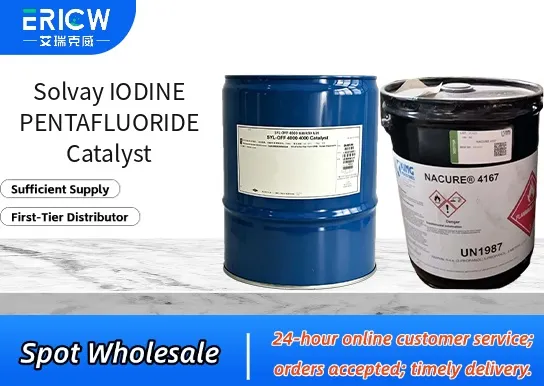
Highly selective fluorinating agent for controlled introduction of fluorine into complex organic molecules.
Exceptional thermal and chemical stability under anhydrous reaction conditions.
Low volatility and reduced handling hazards compared to alternative fluorination reagents (e.g., ClF₃ or BrF₅).
Consistent batch-to-batch performance validated per Solvay’s stringent QC protocols.
Compatible with continuous-flow reactor systems for scalable, safe fluorination processes.
Pharmaceutical synthesis of ¹⁸F-labeled PET tracers via isotopic exchange precursors.
Agrochemical R&D for fluorinated active ingredient development.
Advanced materials manufacturing, including fluorinated liquid crystals and OLED intermediates.
Electrolyte additive synthesis for high-voltage lithium-ion battery formulations.
| Chemical Type | Iodine pentafluoride (IF₅) |
| Product Form | Pure liquid, supplied in sealed nickel-lined steel cylinders |
| Appearance | Colorless to pale yellow fuming liquid |
| Purity (by GC) | ≥ 99.5% |
| Moisture Content (KF) | < 10 ppm |
| Non-Volatile Residue | < 0.001% w/w |
| Primary Applications | Fluorination catalysis in fine chemical, pharmaceutical, and materials synthesis |
| Key Features | Controlled reactivity, low decomposition byproducts, high atom economy |
Q1: What is the primary function of Solvay IODINE PENTAFLUORIDE Catalyst in fluorination reactions?
A: Solvay IODINE PENTAFLUORIDE Catalyst serves as a highly reactive fluorinating agent and Lewis acid catalyst, particularly effective in electrophilic fluorination, halogen exchange (Halex), and selective C–F bond formation under controlled conditions.
Q2: How should this catalyst be handled and stored to ensure stability and safety?
A: Due to its high reactivity with moisture and organic materials, Solvay IODINE PENTAFLUORIDE Catalyst must be handled under inert atmosphere (e.g., dry nitrogen or argon), stored in sealed, moisture-resistant containers, and kept in a cool, dry, well-ventilated area away from incompatible substances such as water, alcohols, or reducing agents.
Q3: Is this catalyst compatible with common fluorination solvents and reactor materials?
A: It demonstrates good compatibility with anhydrous fluorinated solvents (e.g., sulfolane, chlorofluorocarbons, or perfluorinated ethers) and is typically used in reactors constructed from nickel, Monel®, or passivated stainless steel—materials resistant to aggressive fluorinating environments.
Q4: What are key considerations for process scale-up when using this catalyst?
A: Scale-up requires careful attention to heat management, precise stoichiometric control, rigorous exclusion of moisture and oxygen, and compatibility testing with downstream purification steps—especially given the potential for residual iodine species that may require quenching or removal prior to product isolation.
Contact With Us:
E-mail: wangxingqiang@ericwchem.com
Have a Questions? Call Us:
Add:
Building A1, Jiete Industrial Park, Huangpu District, Guangzhou City, Guangdong Province, China