English
 Español
 tiếng việt
 русский
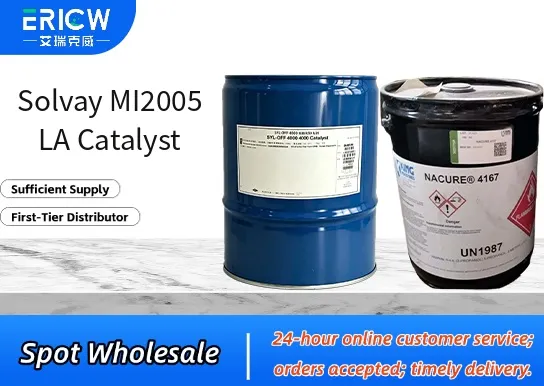
Highly selective Lewis acid catalyst for controlled ring-opening polymerization of cyclic monomers.
Thermally stable up to 180 °C, enabling robust performance in high-temperature processing conditions.
Low residual metal content ensures minimal contamination in sensitive polymer end-products.
Compatible with common industrial solvents including toluene, chlorobenzene, and THF.
Consistent batch-to-batch reproducibility supported by Solvay’s certified manufacturing quality system.
Polymerization of ε-caprolactone for biodegradable polyesters.
Synthesis of poly(lactic acid) (PLA) precursors via lactide ring-opening.
Production of functionalized polyether-ester copolymers for medical device materials.
Catalytic synthesis of specialty polyhydroxyalkanoates (PHAs) in solvent-based processes.
| Chemical Type | Lewis acidic metal complex (aluminum-based) |
| Product Form | Free-flowing crystalline powder |
| Appearance | Off-white to pale yellow solid |
| Primary Applications | Ring-opening polymerization (ROP) of cyclic esters and lactides |
| Key Features | High catalytic activity, low induction period, excellent stereocontrol |
| Benefits | Enables narrow molecular weight distribution (Đ < 1.2) and predictable polymer architecture |
| Storage Conditions | Store under inert atmosphere at 2–8 °C; protect from moisture and light |
| Packaging | Sealed aluminum-laminated pouches or nitrogen-flushed HDPE containers |
Q1: What is the primary function of Solvay MI2005 LA Catalyst in polymer processing?
A: Solvay MI2005 LA Catalyst is a Lewis acid-based catalyst designed to promote controlled crosslinking and condensation reactions—particularly in silicone elastomer and RTV-2 systems—enabling efficient cure development at ambient or elevated temperatures with good pot life balance.
Q2: Is MI2005 LA compatible with platinum-cured silicone formulations?
A: No—MI2005 LA is not intended for use in platinum-catalyzed (hydrosilylation) systems. It is specifically formulated for tin- or other metal-catalyzed condensation-cure chemistries and may interfere with or inhibit platinum activity.
Q3: How should MI2005 LA Catalyst be handled and stored to maintain stability?
A: Store in tightly sealed original containers under dry, cool conditions, protected from moisture and direct sunlight. Due to its sensitivity to hydrolysis, avoid prolonged exposure to ambient humidity during handling; use appropriate personal protective equipment as recommended in the Safety Data Sheet.
Q4: What is the typical dosage range for MI2005 LA in condensation-cure silicone formulations?
A: Dosage depends on formulation requirements, cure profile targets, and base polymer composition, but it is typically used at low concentrations—generally ranging from 0.1% to 2% by weight relative to the total formulation—to achieve effective catalysis without compromising shelf life or final properties.
Contact With Us:
E-mail: wangxingqiang@ericwchem.com
Have a Questions? Call Us:
Add:
Building A1, Jiete Industrial Park, Huangpu District, Guangzhou City, Guangdong Province, China