English
 Español
 tiếng việt
 русский
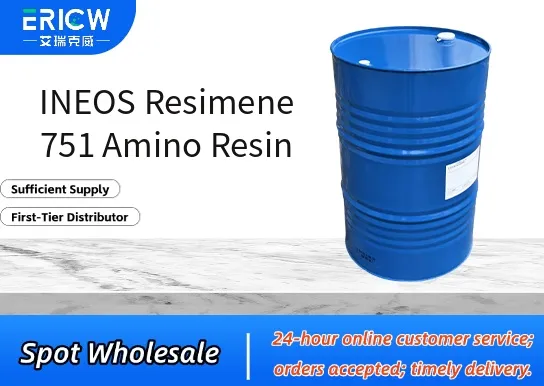
High reactivity with formaldehyde and melamine-based crosslinkers for rapid cure kinetics.
Excellent compatibility with alkyd, polyester, and acrylic resin systems.
Superior storage stability in solvent-based formulations at ambient temperatures.
Low free formaldehyde content meeting stringent global regulatory requirements.
Consistent batch-to-batch performance ensuring reliable coating film formation.
Automotive OEM and refinish topcoats requiring high gloss and durability.
Industrial coil coatings for pre-painted metal substrates.
Appliance finishes demanding excellent hardness and chemical resistance.
General-purpose can coatings for food and beverage containers.
Wood furniture and panel coatings requiring fast through-cure and low VOC.
| Chemical Type | Melamine-formaldehyde condensate |
| Product Form | Liquid |
| Appearance | Clear to slightly hazy, water-white to pale yellow liquid |
| Solvent Content | Approx. 60–65% (isobutanol/butyl acetate blend) |
| Non-Volatile Content | 35–40% w/w |
| Viscosity (25°C, Brookfield RVT, spindle #3, 20 rpm) | 200–500 mPa·s |
| pH (10% aqueous solution) | 7.5–8.5 |
| Free Formaldehyde | <0.3% w/w |
Q1: What is the primary function of Resimene 751 in coating and ink formulations?
A: Resimene 751 is a methylated amino-formaldehyde resin designed to act as a crosslinking agent for hydroxyl- or carbamate-functional polymers, enhancing cure speed, hardness, chemical resistance, and thermal stability in thermosetting systems.
Q2: Is Resimene 751 compatible with common acrylic and polyester resins used in industrial coatings?
A: Yes, Resimene 751 demonstrates broad compatibility with hydroxyl-functional acrylics, polyesters, and alkyds. Its reactivity profile allows for balanced pot life and efficient curing under conventional baking conditions.
Q3: How should Resimene 751 be handled and stored to maintain optimal performance?
A: Store in tightly sealed containers at temperatures between 5 °C and 30 °C, away from direct sunlight and strong oxidizing agents. Prolonged exposure to moisture or elevated temperatures may affect viscosity and reactivity over time.
Q4: Does Resimene 751 require acid catalysts for effective crosslinking?
A: While Resimene 751 can self-cure at elevated temperatures, acid catalysts—such as p-toluenesulfonic acid or blocked sulfonic acids—are typically recommended to lower cure temperature, improve through-cure, and achieve optimal film properties in most industrial applications.
Q5: What are typical dosage ranges for Resimene 751 in thermosetting formulations?
A: Dosage depends on formulation requirements and target performance, but Resimene 751 is generally used at low concentrations—typically ranging from 0.1% to 2% by weight relative to total resin solids—to achieve sufficient crosslink density without compromising flow or flexibility.
Contact With Us:
E-mail: wangxingqiang@ericwchem.com
Have a Questions? Call Us:
Add:
Building A1, Jiete Industrial Park, Huangpu District, Guangzhou City, Guangdong Province, China