English
 Español
 tiếng việt
 русский
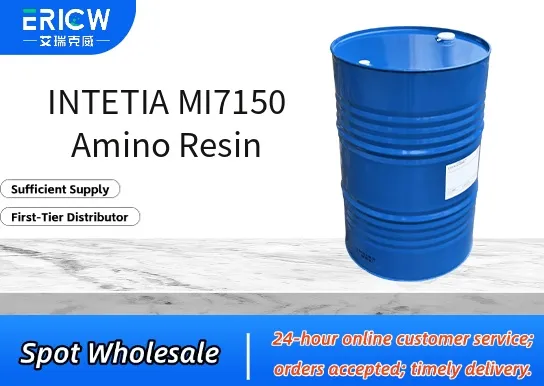
High reactivity with hydroxyl and carboxyl functional groups for rapid crosslinking.
Excellent compatibility with acrylic, polyester, and alkyd resin systems.
Low formaldehyde emission profile, supporting VOC-compliant coating formulations.
Enhanced thermal stability and hardness development in cured film networks.
Consistent batch-to-batch performance ensured through stringent quality control.
Automotive OEM and refinish topcoats.
Industrial coil coatings for metal substrates.
General-purpose can and container coatings.
Wood furniture and cabinetry finishes.
Appliance enamel coatings requiring durability and gloss retention.
| Chemical Type | Methylated melamine-formaldehyde resin |
| Product Form | Liquid |
| Appearance | Clear to slightly hazy, colorless to pale yellow liquid |
| Non-Volatile Content (wt%) | 60 ± 1 |
| Viscosity (mPa·s, 25°C) | 100–200 |
| Density (g/cm³, 25°C) | 1.22–1.26 |
| pH (10% aqueous solution) | 7.8–8.5 |
| Solvent System | Isobutanol / xylene blend |
Q1: What is the primary function of INTETIA MI7150 in coating formulations?
A: INTETIA MI7150 is a melamine-formaldehyde based amino resin designed to act as a crosslinking agent, enhancing hardness, chemical resistance, and thermal stability in thermosetting coatings—particularly for metal decorating and coil coating applications.
Q2: Is INTETIA MI7150 compatible with common acrylic and polyester resins?
A: Yes, INTETIA MI7150 exhibits good compatibility with standard hydroxyl-functional acrylic and polyester resins used in industrial baking finishes. Compatibility should be verified experimentally under intended cure conditions due to formulation-specific variables.
Q3: What are typical curing conditions when using INTETIA MI7150?
A: INTETIA MI7150 is formulated for conventional thermal cure cycles, generally requiring temperatures between 140 °C and 180 °C for 10–30 minutes, depending on substrate, film thickness, and catalyst presence.
Q4: Does INTETIA MI7150 require acid catalysis for efficient crosslinking?
A: While INTETIA MI7150 can undergo self-condensation at elevated temperatures, optimal reactivity and cure speed are typically achieved with a suitable acid catalyst—such as p-toluenesulfonic acid or blocked acid systems—especially in low-bake applications.
Q5: How should INTETIA MI7150 be stored to maintain stability?
A: Store in tightly sealed containers in a cool, dry, and well-ventilated area away from direct sunlight and strong oxidizing agents. Prolonged exposure to high humidity or elevated temperatures may affect viscosity and shelf life.
Contact With Us:
E-mail: wangxingqiang@ericwchem.com
Have a Questions? Call Us:
Add:
Building A1, Jiete Industrial Park, Huangpu District, Guangzhou City, Guangdong Province, China