English
 Español
 tiếng việt
 русский
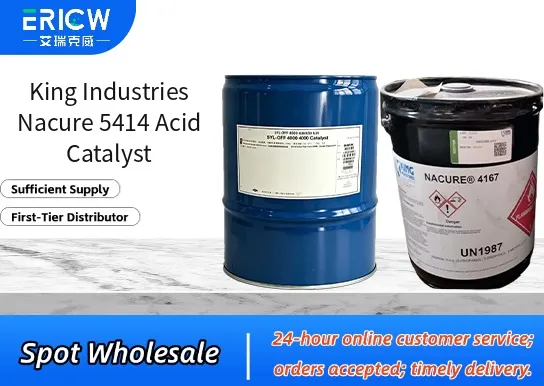
Highly effective low-temperature curing accelerator for amino-formaldehyde resins.
Water-miscible liquid formulation enabling easy incorporation into aqueous systems.
Controlled acid strength minimizes premature gelation and improves pot life stability.
Compatible with melamine–formaldehyde, urea–formaldehyde, and phenolic resin systems.
Non-volatile and low-odor, supporting improved workplace safety and regulatory compliance.
Industrial wood adhesives for plywood and particleboard manufacturing.
Decorative laminates requiring rapid press cycle times and high bond integrity.
Foundry core binders based on thermosetting phenolic or no-bake resin systems.
Coating formulations for metal and wood substrates requiring fast ambient or low-bake cure.
Textile resin finishes to enhance crease resistance and dimensional stability.
| Chemical Type | Sulfonic acid-based catalyst (aromatic sulfonamide derivative) |
| Product Form | Clear, amber liquid |
| Appearance | Homogeneous free-flowing liquid |
| Primary Applications | Amino resin crosslinking in adhesives, coatings, and laminates |
| Key Features | Low-temperature activation, water solubility, non-corrosive to equipment |
| Benefits | Reduced press time, improved shelf life of formulated resins, consistent cure performance |
| pH (10% aqueous solution) | Approx. 2.0–2.5 |
| Storage Stability | Stable ≥12 months at 15–25°C in original sealed container |
Q1: What is the primary function of Nacure 5414 in coating and ink formulations?
A: Nacure 5414 is a latent acid catalyst designed to promote efficient crosslinking of melamine-formaldehyde and other amine-based resins at elevated temperatures, enabling improved cure speed, hardness development, and chemical resistance in thermosetting coatings and overprint varnishes.
Q2: Is Nacure 5414 compatible with waterborne systems?
A: Yes, Nacure 5414 exhibits good compatibility with many waterborne acrylic, polyester, and hybrid resin systems. It remains stable during storage and does not typically cause premature gelation or viscosity instability when properly dispersed and pH-controlled.
Q3: How should Nacure 5414 be incorporated into a formulation?
A: It is typically added during the let-down stage under moderate agitation. Pre-dilution in a compatible solvent or resin solution is recommended to ensure uniform dispersion. Avoid high-shear mixing that may degrade performance, and always verify compatibility with other additives via small-scale trials.
Q4: Does Nacure 5414 require post-cure baking, and what is its activation temperature range?
A: Yes, Nacure 5414 is a thermally activated catalyst—minimal activity occurs at ambient conditions, and effective catalysis begins above approximately 120°C. Full crosslinking is generally achieved between 130°C and 160°C, depending on time, film thickness, and resin reactivity.
Q5: Can Nacure 5414 be used in food-contact compliant coatings?
A: While Nacure 5414 itself is not a food-contact substance, it may be formulated into coatings intended for indirect food contact applications—subject to full regulatory review of the final cured film, including extraction testing and compliance with applicable regional requirements.
Contact With Us:
E-mail: wangxingqiang@ericwchem.com
Have a Questions? Call Us:
Add:
Building A1, Jiete Industrial Park, Huangpu District, Guangzhou City, Guangdong Province, China