English
 Español
 tiếng việt
 русский
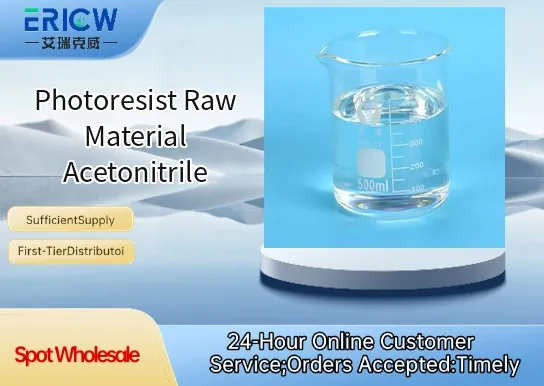
Ultra-high purity (≥99.999%): rigorously purified to minimize metallic impurities (<10 ppt) and particulates (<0.1 µm), critical for defect-free photolithography.
Low water content (<10 ppm): prevents hydrolysis of acid-labile photoresist polymers during formulation and storage.
Consistent batch-to-batch performance: certified with full traceability, GC-MS and ICP-MS analytical reports provided per lot.
Low volatility residue: meets SEMI C36 purity standards for semiconductor-grade solvents used in cleanroom environments.
Non-reactive with common photoacid generators (PAGs) and polymer resins, ensuring formulation stability over extended shelf life.
Primary solvent in advanced 193-nm immersion and EUV photoresist formulations for logic and memory device manufacturing.
Diluent for photoacid generator (PAG) pre-mixing prior to resin incorporation in high-resolution resist casting solutions.
Rinse agent in post-apply bake (PAB) and post-exposure bake (PEB) process validation for low-defect patterning.
Carrier solvent for analytical standard preparation in HPLC and GC-based photoresist quality control labs.
Component in proprietary developer co-solvent systems for optimized dissolution rate uniformity across wafers.
| Chemical Type | Organic nitrile solvent |
| Product Form | Clear, colorless liquid |
| Appearance | Transparent, free of suspended particles or haze |
| Melting Point | −45 °C |
| Boiling Point | 81–82 °C at 760 mmHg |
| Primary Applications | Photoresist formulation, PAG dissolution, cleanroom-compatible rinse |
| Key Features | Ultra-low metals, low water, low halides, high dielectric constant (37.5) |
| Regulatory Compliance | REACH compliant; RoHS 2.0 compatible; no SVHCs above threshold |
| Common Compatible Systems | Suitability |
| JSR ARF Series Resists (e.g., ARF-3000, ARF-4000) | Highly Recommended – Verified compatibility with polymer matrix and PAG stability |
| Tokyo Ohka Kogyo (TOK) EUV Resists (e.g., TMMR-E100 series) | Highly Recommended – Confirmed low outgassing and minimal residue after spin-coating |
| MicroChem S1800 Series Positive Tone Resists | Recommended – Effective solvent for dilution; requires controlled humidity handling |
| DUV Stepper Track Systems (e.g., Tokyo Electron CLEAN TRACK LITHIUS) | Suitable – Fully compatible with dispense modules and waste recovery circuits |
Q1: What is the CAS Registry Number for this acetonitrile grade?
A: The CAS number is 75-05-8. This refers specifically to the ultra-high-purity semiconductor-grade material meeting SEMI C36 specifications.
Q2: What is the typical usage concentration in photoresist formulations?
A: Typically used at 70–90 wt% in final resist casting solutions, depending on polymer molecular weight and desired film thickness; always validated via rheology and spin-coating uniformity testing.
Q3: How does this grade differ from standard ACS-grade acetonitrile?
A: Unlike ACS-grade, this material undergoes additional sub-ppb metal removal, rigorous particle filtration (<0.05 µm), and dedicated packaging in fluorinated ethylene propylene (FEP) bottles to prevent extractables and leachables.
Q4: Is it compliant with USP <846> or ISO 10993 for biocompatibility-related lithography?
A: While not certified for direct medical device contact, it meets ISO 10993-12 extraction protocols for non-cytotoxic solvents and is widely accepted in MEMS and bio-MEMS fabrication where residual solvent migration is assessed per ASTM F748.
Contact With Us:
E-mail: wangxingqiang@ericwchem.com
Have a Questions? Call Us:
Add:
Building A1, Jiete Industrial Park, Huangpu District, Guangzhou City, Guangdong Province, China