English
 Español
 tiếng việt
 русский
Excellent abrasion resistance for extended service life in demanding mechanical environments.
Outstanding elasticity and recovery performance across a wide temperature range (–40 °C to +80 °C).
Good resistance to oils, greases, and non-polar solvents.
Processable via standard thermoplastic techniques including injection molding, extrusion, and blow molding.
Low compression set ensuring dimensional stability under prolonged stress.
Industrial rollers and conveyor belts requiring high wear resistance.
Automotive interior trim components including flexible seals and gaskets.
Technical hoses and tubing for pneumatic and hydraulic systems.
Protective covers and enclosures for electronic and mechanical equipment.
Dynamic elastomeric parts in agricultural and construction machinery.
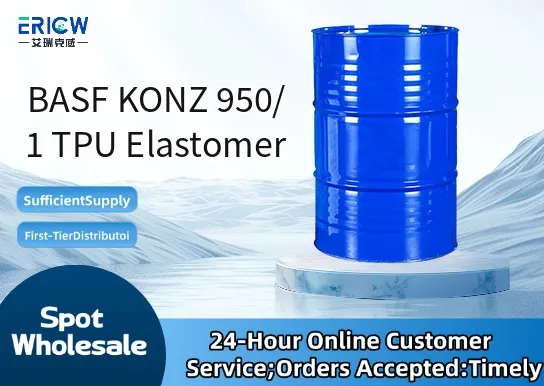
| Chemical Type | Thermoplastic Polyurethane (TPU), polyester-based |
| Product Form | Pellets |
| Appearance | Off-white to light yellow granules |
| Primary Applications | Dynamic mechanical parts, seals, rollers, technical tubing |
| Key Features | High elasticity, abrasion resistance, oil resistance, thermal stability |
| Processing Methods | Injection molding, extrusion, blow molding |
| Density (ISO 1183) | Approx. 1.18–1.20 g/cm³ |
| Melt Flow Index (ISO 1133, 230 °C/5 kg) | Approx. 10–15 g/10 min |
Q1: What is the primary function of BASF KONZ 950/1 in TPU formulations?
A: BASF KONZ 950/1 is a specialized processing aid designed to improve melt flow and reduce extrusion pressure during TPU compounding and shaping processes. It enhances surface finish, reduces die build-up, and supports consistent pelletization or film formation without compromising the inherent mechanical properties of the base TPU.
Q2: Is KONZ 950/1 compatible with aromatic and aliphatic TPU grades?
A: Yes, KONZ 950/1 demonstrates broad compatibility across both aromatic and aliphatic thermoplastic polyurethane systems. Its performance has been validated in standard commercial TPU matrices, including polyester- and polyether-based types, though optimal dispersion and effect may vary depending on molecular weight and soft-segment composition.
Q3: How is KONZ 950/1 typically incorporated into TPU production?
A: It is commonly introduced via masterbatch dilution or direct dry-blend addition prior to extrusion. For best results, pre-mixing with the TPU resin under low-shear conditions is recommended to ensure uniform distribution before high-temperature processing.
Q4: Does KONZ 950/1 affect the thermal stability or long-term aging behavior of TPU?
A: When used within recommended dosage ranges, KONZ 950/1 does not significantly alter the thermal degradation onset temperature or accelerate oxidative aging of typical TPU systems. However, extended residence times at elevated temperatures should be minimized to maintain additive integrity and final part performance.
Contact With Us:
E-mail: wangxingqiang@ericwchem.com
Have a Questions? Call Us:
Add:
Building A1, Jiete Industrial Park, Huangpu District, Guangzhou City, Guangdong Province, China