English
 Español
 tiếng việt
 русский
Excellent abrasion resistance for extended service life in demanding mechanical environments.
High tensile strength and elongation at break, enabling superior elasticity and recovery performance.
Good resistance to oils, greases, and non-polar solvents commonly encountered in industrial applications.
Consistent melt viscosity for reliable processing via extrusion, injection molding, and calendering.
Low-temperature flexibility down to –30 °C without significant loss of elastomeric properties.
Automotive interior trim components including instrument panel skins and door inserts.
Industrial hoses and pneumatic tubing requiring dynamic flexing and pressure resistance.
Footwear midsoles and outsoles where cushioning, rebound, and wear resistance are critical.
Conveyor belts and modular belt segments for food processing and packaging lines.
Medical device tubing and wearable component housings meeting ISO 10993-compatibility requirements.
| Chemical Type | Aliphatic polyester-based thermoplastic polyurethane |
| Product Form | Pellets |
| Appearance | Off-white to light beige, free-flowing granules |
| Primary Applications | Extruded profiles, molded parts, flexible films, and coated fabrics |
| Key Features | High elasticity, low compression set, excellent UV stability |
| Benefits | Reduced part weight vs. rubber, recyclable process scrap, no vulcanization required |
| Density (g/cm³) | 1.18–1.22 |
| Melt Flow Index (230 °C/2.16 kg, g/10 min) | 10–14 |
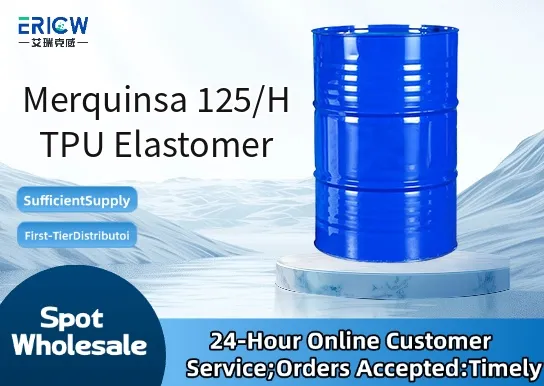
Q1: What is the primary function of Merquinsa 125/H in TPU formulations?
A: Merquinsa 125/H is a high-performance thermoplastic polyurethane (TPU) elastomer designed to enhance melt processability and improve surface finish in extruded or injection-molded TPU parts. It functions as a processing aid and rheology modifier, helping to reduce melt viscosity without significantly compromising mechanical integrity.
Q2: Is Merquinsa 125/H compatible with both polyester- and polyether-based TPUs?
A: Yes — Merquinsa 125/H exhibits broad compatibility across common TPU chemistries, including aromatic and aliphatic polyester- and polyether-type base resins. Compatibility should be verified empirically in final formulations due to potential sensitivity to thermal history and additive interactions.
Q3: How does Merquinsa 125/H affect the mechanical properties of finished TPU products?
A: At typical use levels, Merquinsa 125/H maintains key performance attributes such as tensile strength, elongation at break, and abrasion resistance. Minor reductions in modulus may occur at higher loadings, but these are often offset by improved dimensional stability and reduced internal stress in complex geometries.
Q4: What processing methods is Merquinsa 125/H optimized for?
A: Merquinsa 125/H is especially effective in melt-processing techniques such as twin-screw extrusion, injection molding, and film casting. Its thermal stability supports standard TPU processing temperatures, and it demonstrates good dispersion behavior under high-shear conditions.
Q5: Can Merquinsa 125/H be used in applications requiring regulatory compliance for indirect food contact?
A: Merquinsa 125/H is not pre-certified for food-contact applications. While its base chemistry is consistent with certain food-safe polymer systems, formal regulatory approval must be obtained independently by the end-user based on final formulation, processing conditions, and intended use.
Contact With Us:
E-mail: wangxingqiang@ericwchem.com
Have a Questions? Call Us:
Add:
Building A1, Jiete Industrial Park, Huangpu District, Guangzhou City, Guangdong Province, China