English
 Español
 tiếng việt
 русский
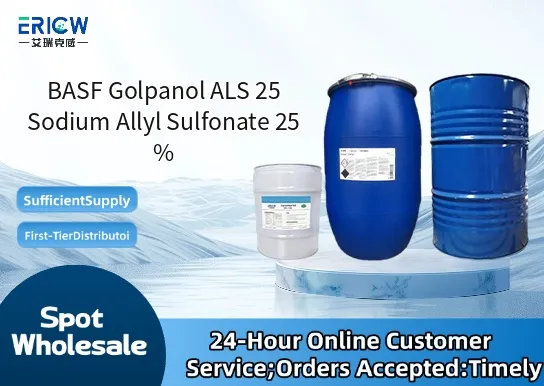
Highly water-soluble anionic surfactant with excellent electrolyte tolerance.
Provides superior foaming stability and foam volume retention under hard water conditions.
Offers low skin irritation potential, supporting mildness in personal care formulations.
Chemically stable across broad pH range (pH 4–10), suitable for acid- and base-stable systems.
Enables effective viscosity building and synergistic thickening when combined with common co-surfactants.
Shampoos and body washes requiring rich, creamy lather and gentle cleansing.
Hand soaps and liquid cleansers where high foam persistence and rinsability are critical.
Industrial and institutional (I&I) cleaning formulations demanding robust performance in cold water.
Color-safe laundry detergents needing low-foam control and fabric compatibility.
Specialty emulsion polymerization processes as a reactive surfactant stabilizer.
| Chemical Type | Sodium allyl sulfonate (SAS)-based anionic surfactant |
| Product Form | Aqueous solution (25% active content) |
| Appearance | Clear, colorless to pale yellow liquid |
| pH (10% aqueous solution, 25°C) | 6.5 – 8.0 |
| Active Content (by weight) | 24.5 – 25.5% |
| Density (20°C) | 1.03 – 1.06 g/cm³ |
| Primary Applications | Personal care cleansing, I&I cleaners, polymerization stabilizer |
| Regulatory Compliance | REACH registered; compliant with EU Cosmetics Regulation (EC) No 1223/2009 |
| Common Compatible Systems | Suitability |
| Alkyl ether sulfates (AES) | Highly Recommended – Strong synergy in foam volume and stability |
| Amphoteric betaines (e.g., cocamidopropyl betaine) | Highly Recommended – Enhances mildness and viscosity without precipitation |
| Nonionic surfactants (e.g., alkyl polyglucosides, alcohol ethoxylates) | Recommended – Good compatibility; may require optimization for clarity |
| Acrylic acid-based thickeners (e.g., carbomers) | Suitable – Stable at pH >5.5; avoid prolonged exposure to strong acid conditions |
Q1: What is the CAS number for Sodium Allyl Sulfonate?
A: The CAS number for sodium allyl sulfonate (the active ingredient) is 24307-26-4.
Q2: What is the recommended usage level in shampoo formulations?
A: Typical use levels range from 3–10% (w/w) in final formulations, depending on desired foaming profile, viscosity, and mildness requirements.
Q3: How does Golpanol ALS 25 compare to sodium lauryl sulfate (SLS) or sodium laureth sulfate (SLES)?
A: Unlike SLS/SLES, Golpanol ALS 25 offers significantly lower irritation potential, better hard-water tolerance, and inherent polymerizable functionality — making it suitable for both end-use formulations and reactive applications.
Q4: Is Golpanol ALS 25 compliant with COSMOS and Ecocert standards?
A: While the base molecule is chemically compatible with natural/clean criteria, Golpanol ALS 25 is not currently certified under COSMOS or Ecocert due to its synthetic origin and manufacturing process; users should consult BASF’s latest Eco-Profile documentation for formulation-level assessments.
Q5: Does Golpanol ALS 25 exhibit migration or extraction concerns in packaging?
A: No significant migration has been observed in standard HDPE, PET, or aluminum-laminated packaging under typical storage conditions (≤40°C, ≤24 months); compatibility testing with specific packaging materials is recommended for long-term commercial use.
Contact With Us:
E-mail: wangxingqiang@ericwchem.com
Have a Questions? Call Us:
Add:
Building A1, Jiete Industrial Park, Huangpu District, Guangzhou City, Guangdong Province, China