English
 Español
 tiếng việt
 русский
High reactivity with melamine-formaldehyde and urea-formaldehyde resins for rapid crosslinking.
Excellent compatibility with acrylic, polyester, and alkyd resin systems.
Low formaldehyde emission profile meeting stringent VOC and regulatory requirements.
Enhanced thermal stability enabling durable performance in high-bake coatings.
Consistent batch-to-batch quality with tight control over molecular weight distribution.
Automotive OEM and refinish topcoats requiring high gloss and chip resistance.
Industrial coil coatings for pre-painted metal substrates.
Baking enamels for appliances and metal furniture.
Can coatings for food and beverage packaging.
General-purpose industrial maintenance coatings.
| Chemical Type | Melamine-formaldehyde modified amino resin |
| Product Form | Liquid |
| Appearance | Clear to slightly hazy, pale yellow liquid |
| Solvent Content | Butanol/water mixture (approx. 60–65% solids) |
| pH (10% aqueous solution) | 7.8–8.5 |
| Viscosity (25°C, Brookfield RV, spindle #3, 20 rpm) | 200–400 cP |
| Reactivity Profile | Medium-to-high cure speed at 140–180°C |
| Storage Stability | ≥12 months at 20–25°C in sealed container |
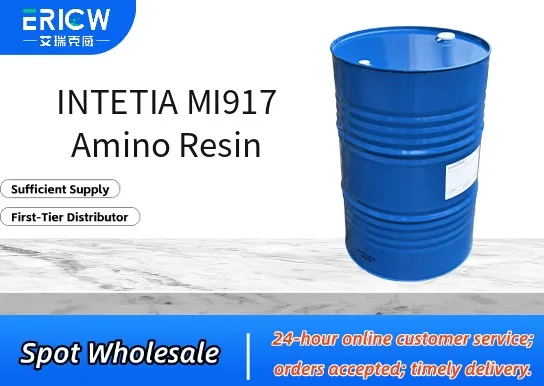
Q1: What is the primary function of INTETIA MI917 in coating formulations?
A: INTETIA MI917 is a methylated amino resin designed to serve as a crosslinking agent for hydroxyl-functional resins—such as acrylics, polyesters, and alkyds—in thermosetting coatings. It enhances cure speed, hardness, chemical resistance, and film integrity under thermal curing conditions.
Q2: Is INTETIA MI917 compatible with acid-catalyzed systems?
A: Yes, it is commonly used with strong or weak organic acid catalysts (e.g., p-toluenesulfonic acid or blocked acids) to promote efficient crosslinking at moderate bake temperatures. Catalyst selection and concentration should be optimized based on the base resin system and desired cure profile.
Q3: How does INTETIA MI917 compare to other melamine-formaldehyde resins in terms of solubility and storage stability?
A: INTETIA MI917 offers good solubility in common organic solvents (e.g., xylene, butanol, and esters) and exhibits favorable storage stability when kept in sealed containers under cool, dry conditions. Its high degree of methylation contributes to reduced self-condensation tendency compared to partially alkylated or unmodified melamine resins.
Q4: Can INTETIA MI917 be used in low-bake or ambient-cure applications?
A: While optimized for thermal cure (typically 120–160 °C), modified catalytic systems or reactive co-resins may extend its utility to lower-temperature or forced-dry scenarios. However, full network development and optimal performance are generally achieved under conventional thermal curing conditions.
Q5: What safety and handling precautions should be observed when working with INTETIA MI917?
A: As with most amino resins, appropriate personal protective equipment (PPE)—including gloves, safety goggles, and adequate ventilation—is recommended during handling. Avoid prolonged skin contact and inhalation of mists or vapors. Refer to the current Safety Data Sheet (SDS) for detailed toxicological and first-aid information.
Contact With Us:
E-mail: wangxingqiang@ericwchem.com
Have a Questions? Call Us:
Add:
Building A1, Jiete Industrial Park, Huangpu District, Guangzhou City, Guangdong Province, China