English
 Español
 tiếng việt
 русский
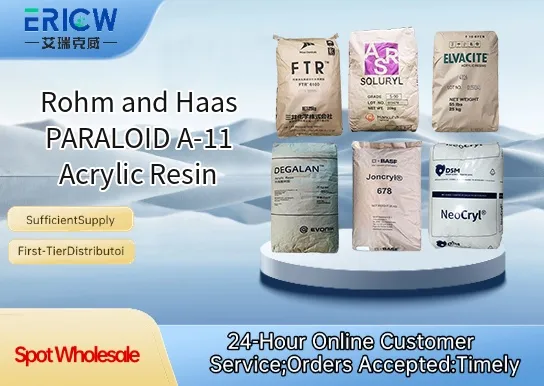
High gloss and excellent clarity for premium aesthetic performance.
Good compatibility with nitrocellulose, CAB, and other common film formers.
Excellent UV resistance and long-term color stability.
Low viscosity solution enabling easy formulation and high solids content.
Outstanding adhesion to diverse substrates including wood, metal, and plastics.
Automotive refinish clearcoats and basecoats.
Industrial maintenance coatings for machinery and equipment.
Wood furniture and cabinet finishes.
Plastic coatings for consumer electronics and appliances.
General-purpose protective topcoats requiring durability and gloss.
| Chemical Type | Acrylic copolymer |
| Product Form | Solution in toluene/ethyl acetate (approx. 50% solids) |
| Appearance | Clear, water-white liquid |
| Primary Applications | Clearcoats, topcoats, and high-gloss industrial finishes |
| Key Features | UV stability, gloss retention, substrate adhesion |
| Benefits | Enhanced durability, ease of formulation, reduced VOC impact vs. traditional resins |
| Storage Stability | Stable under recommended conditions (cool, dry, sealed container) |
Q1: What is the primary function of PARALOID A-11 in coating formulations?
A: PARALOID A-11 is a solution-grade acrylic resin designed primarily as a rheology modifier and performance enhancer in solvent-borne and high-solids coatings. It improves flow, leveling, and sag resistance while contributing to film clarity, gloss retention, and substrate adhesion.
Q2: Is PARALOID A-11 compatible with common crosslinkers used in industrial coatings?
A: Yes, PARALOID A-11 exhibits good compatibility with melamine-formaldehyde, urea-formaldehyde, and blocked isocyanate crosslinkers in thermosetting systems. Its hydroxyl functionality supports co-reactivity, though optimal performance should be confirmed through formulation testing under intended cure conditions.
Q3: How does PARALOID A-11 affect film hardness and flexibility?
A: As a relatively low-Tg acrylic resin, PARALOID A-11 enhances film flexibility and impact resistance without significantly compromising hardness—especially when blended with higher-Tg resins. The balance between hardness and toughness can be tuned by adjusting its concentration and selection of co-resins.
Q4: Can PARALOID A-11 be used in UV-curable systems?
A: PARALOID A-11 is not inherently UV-reactive and is not formulated for direct use in 100% UV-curable systems. However, it may be incorporated at low levels into hybrid UV/solvent or UV/thermal systems where solubility and compatibility are maintained—subject to evaluation of final cure performance and film properties.
Contact With Us:
E-mail: wangxingqiang@ericwchem.com
Have a Questions? Call Us:
Add:
Building A1, Jiete Industrial Park, Huangpu District, Guangzhou City, Guangdong Province, China