English
 Español
 tiếng việt
 русский
Effective broad-spectrum biocidal activity against bacteria, fungi, and algae.
Stable in acidic to neutral pH ranges (pH 3–7), ensuring compatibility with common process water systems.
Low volatility and minimal odor, supporting safer handling and reduced worker exposure concerns.
Compatible with common non-oxidizing biocides and many water treatment additives for synergistic dosing strategies.
Designed for continuous or slug dosing in recirculating cooling water and industrial process water applications.
Recirculating cooling water systems in power generation and manufacturing facilities.
Process water circuits in paper and pulp mills.
Industrial closed-loop systems requiring microbial control without oxidant interference.
Make-up water treatment for HVAC chillers and heat exchangers.
Preservation of aqueous metalworking fluids during storage and operation.
| Chemical Type | Thiocarbamate-based non-oxidizing biocide |
| Product Form | Liquid concentrate |
| Appearance | Clear, pale yellow to amber liquid |
| Primary Applications | Cooling water, process water, metalworking fluids |
| Key Features | Broad-spectrum efficacy, pH stability, low volatility |
| Benefits | Reduced biofilm formation, extended system run time, compatibility with common additives |
| Storage Stability | ≥12 months at 5–30 °C in original unopened container |
| Recommended Dosage Range | 50–200 ppm active ingredient (varies by system conditions) |
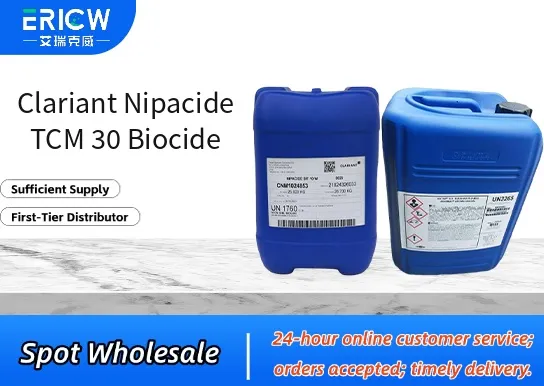
Q1: What is the primary mode of action of Nipacide TCM 30 Biocide?
A: Nipacide TCM 30 Biocide functions as a broad-spectrum antimicrobial agent, primarily inhibiting microbial growth through disruption of essential cellular processes in bacteria, yeasts, and molds. Its active ingredient is designed for effective preservation in water-based systems without compromising formulation stability.
Q2: In which types of industrial formulations is Nipacide TCM 30 typically used?
A: It is commonly applied in water-miscible metalworking fluids, industrial cleaning agents, latex paints, adhesives, and other aqueous process or end-use products where long-term microbiological control is required during storage and application.
Q3: Is Nipacide TCM 30 compatible with common surfactants and thickeners used in industrial formulations?
A: Yes, Nipacide TCM 30 demonstrates good compatibility with a wide range of nonionic and anionic surfactants, cellulose ethers, associative thickeners, and common emulsifiers—making it suitable for complex, multi-component systems.
Q4: How should Nipacide TCM 30 be incorporated into a formulation?
A: It is recommended to add Nipacide TCM 30 during the cool-down phase or at ambient temperature, after high-shear mixing and pH adjustment. Pre-dilution with water or a compatible solvent may aid uniform dispersion, especially in viscous systems.
Contact With Us:
E-mail: wangxingqiang@ericwchem.com
Have a Questions? Call Us:
Add:
Building A1, Jiete Industrial Park, Huangpu District, Guangzhou City, Guangdong Province, China