English
 Español
 tiếng việt
 русский
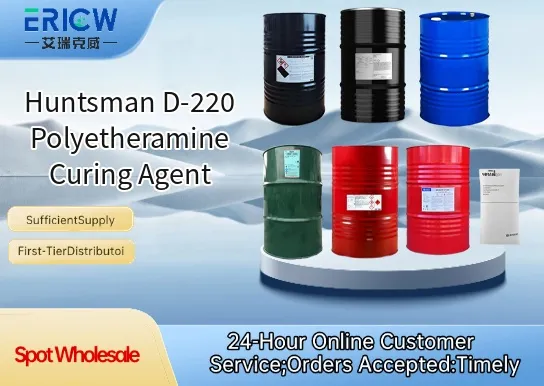
Low-viscosity liquid enables easy handling, metering, and mixing with epoxy resins.
Fast-reacting aliphatic polyetheramine delivers rapid room-temperature cure kinetics.
Provides excellent flexibility, impact resistance, and low-temperature toughness in cured epoxy systems.
Offers superior moisture tolerance compared to conventional amine curing agents.
Enables formulation of low-VOC, solvent-free epoxy coatings and adhesives.
High-performance industrial maintenance coatings for steel and concrete substrates.
Structural adhesives in transportation and wind energy composite bonding.
Electrical encapsulants and potting compounds requiring fast turnaround and low exotherm.
Flooring systems including self-leveling and decorative epoxy mortars.
Repair mortars and grouts for infrastructure rehabilitation.
| Chemical Type | Aliphatic polyetheramine (diamine) |
| Product Form | Clear, colorless to pale yellow liquid |
| Appearance | Homogeneous liquid, free from visible particulates or phase separation |
| Amine Value | 195–205 mg KOH/g |
| Viscosity (25°C) | 80–120 cP |
| Primary Applications | Epoxy coating, adhesive, and composite curing agent |
| Key Features | Room-temperature cure, low viscosity, flexible network formation |
| Benefits | Improved processing, reduced cycle time, enhanced toughness and chemical resistance |
Q1: What is the primary role of D-220 in epoxy formulations?
A: D-220 functions as a reactive polyetheramine curing agent that enables rapid ambient- or low-temperature cure of epoxy resins, delivering flexible, toughened networks with good chemical resistance and low viscosity for ease of processing.
Q2: How does D-220 compare to traditional aliphatic amine curing agents in terms of handling and safety?
A: D-220 exhibits significantly lower volatility and reduced skin sensitization potential compared to many conventional aliphatic amines, offering improved workplace safety and longer pot life without compromising reactivity.
Q3: Can D-220 be used in combination with other curing agents or accelerators?
A: Yes — D-220 is commonly blended with other amines, anhydrides, or latent catalysts to tailor cure profile, flexibility, and thermal performance; compatibility should be verified experimentally for each specific formulation.
Q4: What types of epoxy resins is D-220 most commonly paired with?
A: D-220 is widely used with standard liquid bisphenol-A and bisphenol-F epoxies, as well as novolac and cycloaliphatic epoxies, particularly where enhanced toughness, moisture tolerance, and reduced exotherm are desired.
Contact With Us:
E-mail: wangxingqiang@ericwchem.com
Have a Questions? Call Us:
Add:
Building A1, Jiete Industrial Park, Huangpu District, Guangzhou City, Guangdong Province, China