English
 Español
 tiếng việt
 русский
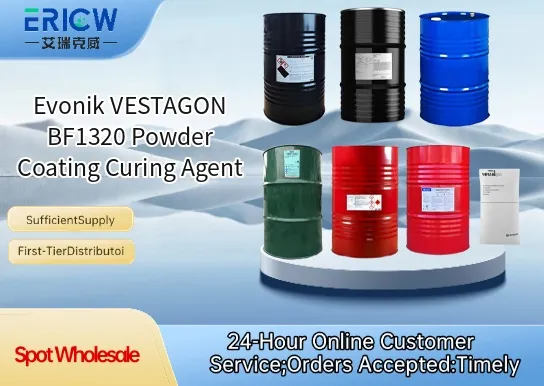
High reactivity with epoxy resins enabling rapid cure at low temperatures (160–180 °C).
Excellent flow and leveling properties for smooth, high-gloss finishes.
Low volatility and minimal yellowing tendency—ideal for aesthetic-sensitive applications.
Good storage stability as a free-flowing powder under standard ambient conditions.
Compliant with major global regulatory frameworks including REACH and RoHS.
Architectural metal cladding and façade systems.
Automotive under-hood components requiring thermal resistance.
Office furniture and household appliance housings.
Industrial equipment enclosures and electrical cabinets.
Outdoor lighting fixtures exposed to UV and weathering.
| Chemical Type | Imidazoline-based latent curing agent |
| Product Form | Free-flowing white to off-white powder |
| Appearance | Uniform fine granular powder |
| Primary Applications | Epoxy-based and hybrid (epoxy-polyester) powder coatings |
| Key Features | Low-temperature cure, low odor, excellent film integrity |
| Benefits | Energy savings, reduced VOC emissions, enhanced edge coverage |
| Recommended Storage | Below 25 °C in dry, well-ventilated conditions |
| Shelf Life | 24 months from date of manufacture when stored properly |
Q1: What is the primary function of VESTAGON BF1320 in powder coating formulations?
A: VESTAGON BF1320 is a blocked aliphatic polyisocyanate curing agent designed to enable low-temperature curing of hydroxyl-functional polyester and acrylic resins in thermosetting powder coatings. It provides excellent storage stability in the uncured powder while enabling efficient crosslinking upon thermal activation.
Q2: What is the typical recommended curing temperature range for systems using BF1320?
A: BF1320 is formulated for mid-to-low temperature cure profiles, generally enabling full crosslinking between 140 °C and 160 °C with standard dwell times of 15–25 minutes. Exact conditions depend on substrate type, film thickness, and overall formulation balance.
Q3: How does BF1320 compare to conventional aromatic isocyanate-based curing agents in terms of performance and handling?
A: Unlike aromatic alternatives, BF1320 offers superior UV stability and reduced yellowing potential due to its aliphatic backbone. It also exhibits lower volatility and improved handling safety in powder form, with no free isocyanate monomer present under normal storage conditions.
Q4: Is BF1320 compatible with standard powder coating production equipment and processes?
A: Yes — BF1320 is fully compatible with conventional dry-blending, extrusion, and grinding steps used in thermoset powder manufacturing. Its physical form as a free-flowing crystalline powder ensures uniform dispersion and avoids agglomeration during processing.
Contact With Us:
E-mail: wangxingqiang@ericwchem.com
Have a Questions? Call Us:
Add:
Building A1, Jiete Industrial Park, Huangpu District, Guangzhou City, Guangdong Province, China