English
 Español
 tiếng việt
 русский
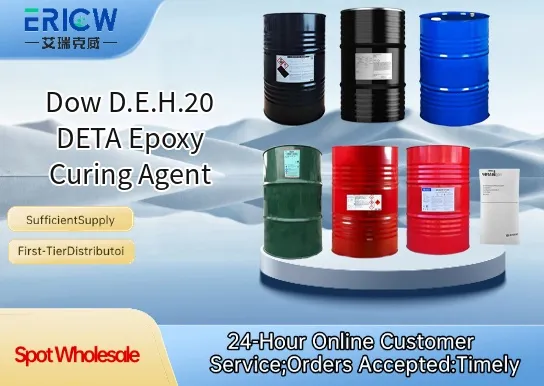
Fast-reacting aliphatic amine curing agent for ambient and elevated temperature epoxy systems.
Provides excellent adhesion to metals, concrete, and composite substrates.
Delivers good chemical resistance, particularly to alkalis and mild solvents.
Enables low-viscosity formulations for easy mixing and improved wetting of fillers and reinforcements.
Offers balanced mechanical properties including high tensile strength and impact resistance in cured networks.
Structural adhesives for aerospace and automotive bonding.
Protective coatings for industrial flooring and concrete repair.
Electrical encapsulants and potting compounds for electronic components.
Composite matrix resins for filament-wound tanks and pultruded profiles.
| Chemical Type | Diethylenetriamine (DETA)-based aliphatic polyamine |
| Product Form | Liquid |
| Appearance | Clear, light amber liquid |
| Amine Value | 540–570 mg KOH/g |
| Viscosity at 25°C | 100–150 mPa·s |
| Density at 25°C | 0.95–0.98 g/cm³ |
| Reactive Hydrogen Equivalent Weight | ~23 g/eq |
| Primary Applications | Epoxy resin curing for adhesives, coatings, composites, and encapsulants |
Q1: What is the primary function of Dow D.E.H.20 in epoxy systems?
A: Dow D.E.H.20 is a diethylenetriamine (DETA)-based aliphatic amine curing agent designed to react with epoxy resins, enabling crosslinking and development of thermoset properties such as chemical resistance, mechanical strength, and thermal stability.
Q2: How does Dow D.E.H.20 compare to other aliphatic amine curing agents in terms of reactivity and handling?
A: Compared to faster-reacting aliphatic amines, Dow D.E.H.20 offers moderate reactivity, providing a more workable pot life for industrial applications such as coatings, adhesives, and composites—while still delivering efficient cure at ambient or elevated temperatures.
Q3: Is Dow D.E.H.20 suitable for use in high-performance protective coatings?
A: Yes—it is commonly formulated into corrosion-resistant and abrasion-resistant coatings for infrastructure, marine, and industrial maintenance applications, where its ability to promote dense crosslinking contributes to barrier performance and substrate adhesion.
Q4: What are key formulation considerations when using Dow D.E.H.20?
A: Formulators should consider resin type, desired cure profile, and end-use environmental exposure. Dow D.E.H.20 is typically used at low concentrations relative to the epoxy resin, and dosage depends on formulation requirements—including stoichiometry, viscosity targets, and final film properties.
Contact With Us:
E-mail: wangxingqiang@ericwchem.com
Have a Questions? Call Us:
Add:
Building A1, Jiete Industrial Park, Huangpu District, Guangzhou City, Guangdong Province, China