English
 Español
 tiếng việt
 русский
High thermal stability up to 250 °C for extended service life in demanding environments.
Excellent weather resistance and UV stability for long-term outdoor performance.
Good compatibility with organic resins and pigments, enabling flexible formulation design.
Low surface energy providing superior water repellency and anti-graffiti properties.
Hydrolytically stable siloxane backbone ensures consistent performance under humid conditions.
High-performance exterior wall coatings for architectural facades.
Water-repellent impregnation treatments for concrete and natural stone.
Heat-resistant topcoats for industrial metal substrates.
Binders in silicone-modified stucco and render systems.
Functional additives in protective clear coats for façade systems.
| Chemical Type | Methyl-phenyl silicone resin |
| Product Form | Liquid solution (solvent-based) |
| Appearance | Clear, colorless to pale yellow liquid |
| Solvent | Xylene / aromatic hydrocarbon mixture |
| Solids Content | Approx. 50 wt.% |
| Viscosity (25 °C) | Approx. 100–200 mPa·s |
| Density (20 °C) | Approx. 0.92–0.95 g/cm³ |
| Flash Point (PMCC) | Approx. 45 °C |
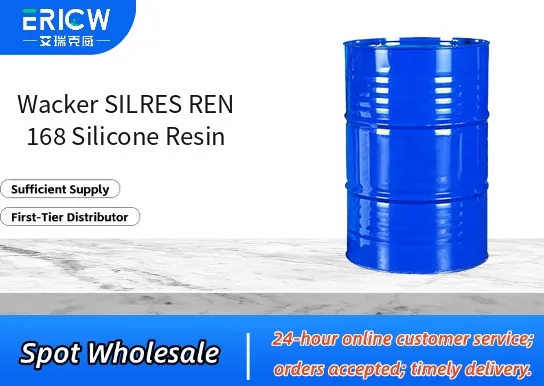
Q1: What is the primary function of SILRES REN 168 in coating and ink formulations?
A: SILRES REN 168 is a reactive silicone resin designed to enhance surface properties—particularly slip, mar resistance, and substrate wetting—while maintaining compatibility with organic polymer systems. It functions as a crosslinking additive or surface modifier, improving durability without significantly compromising film flexibility or gloss.
Q2: Is SILRES REN 168 compatible with water-based systems?
A: Yes, SILRES REN 168 is formulated for use in both solvent-borne and water-based systems. It disperses readily in aqueous media when properly incorporated—typically with mild mechanical agitation—and remains stable in neutral to slightly alkaline pH ranges commonly found in architectural and industrial waterborne coatings.
Q3: How should SILRES REN 168 be incorporated into a formulation?
A: It is recommended to add SILRES REN 168 during the let-down or post-additive stage, after pigments and main binders are fully dispersed. Gentle mixing at low shear is sufficient; high-shear dispersion is not required. Dosage depends on formulation requirements but is typically used at low concentrations to achieve optimal surface effects without phase separation.
Q4: Does SILRES REN 168 affect curing behavior in thermosetting systems?
A: SILRES REN 168 contains reactive silanol groups that can participate in condensation reactions under heat or catalytic conditions. In thermosetting systems—such as amino- or melamine-cured acrylics—it may contribute to additional network formation, potentially increasing crosslink density and enhancing hardness or chemical resistance, though the extent depends on cure schedule and co-resin reactivity.
Contact With Us:
E-mail: wangxingqiang@ericwchem.com
Have a Questions? Call Us:
Add:
Building A1, Jiete Industrial Park, Huangpu District, Guangzhou City, Guangdong Province, China