English
 Español
 tiếng việt
 русский
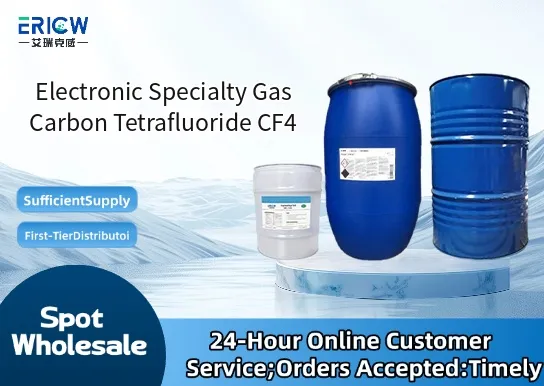
Ultra-high purity (≥99.999% / 5N) with stringent control of moisture, oxygen, and hydrocarbon impurities.
Exceptional thermal and chemical stability—non-reactive with silicon, silicon dioxide, and most chamber materials under plasma conditions.
Low global warming potential (GWP = 7380) relative to other perfluorocarbons—optimized for modern environmental stewardship protocols.
Consistent vapor pressure and predictable etch rate performance across wafer fabrication processes.
Supplied in certified, electropolished stainless-steel cylinders with VCR® or DISS fittings to prevent contamination and ensure leak-tight delivery.
Plasma etching of silicon dioxide (SiO₂) and silicon nitride (Si₃N₄) in semiconductor front-end-of-line (FEOL) processing.
Chamber cleaning in CVD and PECVD tools—effectively removes silicon-based residues without damaging underlying layers.
Dielectric film patterning for advanced logic and memory devices (e.g., DRAM, NAND flash).
Atomic layer etching (ALE) precursor in next-generation sub-5nm node development.
Gas blending component in high-precision multi-gas mixtures (e.g., CF₄/CHF₃/O₂, CF₄/Ar) for tunable selectivity and anisotropy.
| Chemical Type | Perfluorocarbon (PFC), inorganic fluorinated compound |
| Product Form | Compressed liquefied gas |
| Appearance | Colorless, odorless gas at ambient temperature |
| Melting Point | −183.6 °C |
| Boiling Point | −128 °C |
| Primary Applications | Semiconductor plasma etching & chamber cleaning |
| Key Features | High etch rate for SiO₂; low polymer deposition; excellent process repeatability |
| Regulatory Compliance | Meets SEMI G47-0322 (Electronic Grade), ISO 8573-1 Class 1:1:1 for particulates/moisture/oil, REACH & RoHS compliant |
| Common Compatible Systems | Suitability |
| Applied Materials Centura® & Endura® Platforms | Highly Recommended – Validated for etch and clean modules with standard gas delivery architecture |
| Lam Research Kiyo® & Flex® Etch Systems | Highly Recommended – Optimized flow dynamics and RF coupling for CF₄-based chemistries |
| Tokyo Electron (TEL) Unity™ & Telius® Platforms | Recommended – Requires optional moisture/oxygen scrubber integration for ultra-low impurity requirements |
| ASM International Eagle® PECVD Tools | Suitable – Effective for chamber conditioning; verify compatibility with quartz showerhead components |
Q1: What is the CAS Number for electronic-grade carbon tetrafluoride?
A: The CAS Registry Number for carbon tetrafluoride is 75-73-0.
Q2: How does CF₄ compare to C₂F₆ or SF₆ in terms of etch selectivity and residue formation?
A: CF₄ offers higher SiO₂/Si selectivity than C₂F₆ and lower polymerization tendency than SF₆—making it preferred for high-fidelity oxide etching where sidewall passivation must be minimized.
Q3: Is electronic-grade CF₄ subject to EU F-Gas Regulation restrictions?
A: Yes—CF₄ is listed as a fluorinated greenhouse gas under EU Regulation (EU) No 517/2014; however, its use in semiconductor manufacturing is exempted under Article 11(2) for essential industrial applications with no technically feasible alternatives.
Q4: Can CF₄ be extracted from cylinder manifolds without phase separation or composition drift?
A: Yes—CF₄ remains fully gaseous above −128 °C and exhibits negligible liquid-phase fractioning; consistent composition is maintained during withdrawal using heated manifolds and pressure-regulated delivery systems.
Contact With Us:
E-mail: wangxingqiang@ericwchem.com
Have a Questions? Call Us:
Add:
Building A1, Jiete Industrial Park, Huangpu District, Guangzhou City, Guangdong Province, China