English
 Español
 tiếng việt
 русский
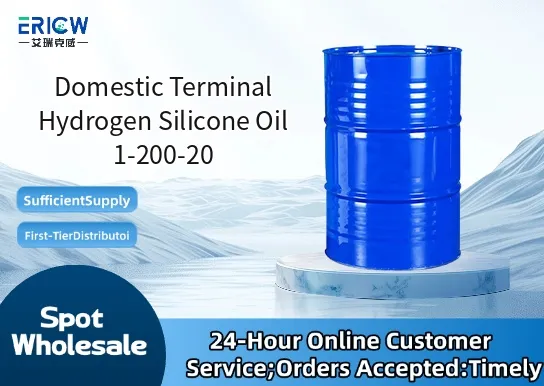
Terminal hydrogen-functional silicone fluid offering controlled reactivity for precise hydrosilylation crosslinking.
Low volatility and excellent thermal stability up to 200 °C in inert atmospheres.
High purity with minimal cyclic siloxane (D4–D6) content, supporting regulatory compliance for sensitive applications.
Clear, colorless to pale yellow liquid with low viscosity (20–30 cSt at 25 °C), ensuring easy handling and metering.
Hydrogen content of ~0.18–0.22 wt%, optimized for consistent catalytic efficiency with Pt-based systems.
Formulation of addition-cure liquid silicone rubber (LSR) for medical device components and infant care products.
Functional additive in high-performance release coatings for food-grade and pharmaceutical packaging papers.
Crosslinker in heat-curable silicone gels used in electronics encapsulation and thermal interface materials.
Reactive diluent in platinum-catalyzed silicone adhesives requiring low shrinkage and high adhesion retention.
Base fluid modification agent for specialty silicone emulsions in textile and leather finishing.
| Chemical Type | Linear poly(methylhydrosiloxane) with terminal Si–H groups |
| Product Form | Clear, mobile liquid |
| Appearance | Colorless to pale yellow, transparent, no visible particulates |
| Viscosity (25 °C) | 20–30 cSt (ASTM D2161) |
| Hydrogen Content | 0.18–0.22 wt% (by ASTM D5853) |
| Flash Point (COC) | >180 °C (ASTM D92) |
| Volatility (150 °C, 4 h) | <1.5% weight loss (ASTM D4292) |
| Regulatory Compliance | Meets USP <87>/<88> Class VI extractables profile; compliant with EU REACH SVHC <0.1% |
| Common Compatible Systems | Suitability |
| Platinum complex catalysts (e.g., Karstedt’s, Ashby’s) | Highly Recommended – Rapid, reproducible hydrosilylation with low Pt loading (5–50 ppm) |
| Alkyl silicate crosslinkers (e.g., tetraethyl orthosilicate) | Suitable – Requires acid catalyst co-addition; limited use in moisture-cure systems |
| Condensation-cure silicone polymers (e.g., RTV-1/2) | Not Recommended – Incompatible due to competing reaction mechanisms and inhibition risks |
| Polydimethylsiloxane (PDMS) base fluids | Recommended – Fully miscible; enables viscosity adjustment without phase separation |
Q1: What is the CAS Registry Number for Domestic Terminal Hydrogen Silicone Oil 1-200-20?
A: The CAS number is 63148-62-9 (generic for linear methylhydrosiloxane polymers); batch-specific confirmation available upon request with CoA.
Q2: What is the recommended dosage range when used as a crosslinker in LSR formulations?
A: Typical Si–H to vinyl molar ratio is 1.1:1 to 1.5:1; dosage generally ranges from 0.8–2.5 phr relative to vinyl-terminated PDMS base polymer.
Q3: How does this product differ from standard methylhydrosiloxane-dimethylsiloxane copolymers (e.g., HMDZ)?
A: Unlike random copolymers, 1-200-20 features exclusively terminal Si–H functionality—enabling predictable stoichiometry, reduced side reactions, and superior network uniformity in cured elastomers.
Q4: Is extraction or migration observed in food-contact applications under standard conditions?
A: No significant migration detected per FDA 21 CFR §177.2600 and EU Regulation (EC) No 1935/2004 testing protocols when fully cured; residual monomer and volatile content are strictly controlled below 100 ppm.
Contact With Us:
E-mail: wangxingqiang@ericwchem.com
Have a Questions? Call Us:
Add:
Building A1, Jiete Industrial Park, Huangpu District, Guangzhou City, Guangdong Province, China