English
 Español
 tiếng việt
 русский
Highly selective palladium-based heterogeneous catalyst for efficient hydrogenation reactions.
Exceptional thermal and chemical stability under continuous industrial process conditions.
Low metal leaching ensures product purity and extends catalyst service life.
Engineered for easy handling, filtration, and regeneration in fixed-bed or slurry-phase reactors.
Consistent batch-to-batch performance supported by rigorous quality control per ISO 9001 standards.
Hydrogenation of nitroaromatics to aromatic amines in fine chemical synthesis.
Selective reduction of alkenes and alkynes in pharmaceutical intermediate manufacturing.
Catalytic dechlorination of chlorinated organic compounds in environmental remediation processes.
Hydrogenative amination reactions for agrochemical active ingredient production.
Refining of specialty esters and unsaturated fatty acid derivatives in oleochemical processing.
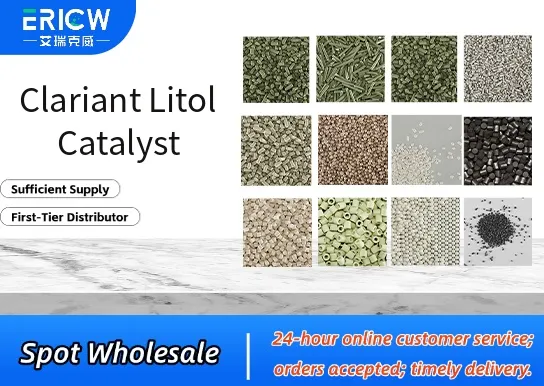
| Chemical Type | Palladium on activated carbon (Pd/C) |
| Product Form | Free-flowing black granular solid |
| Appearance | Uniform black granules, no visible dust or friability |
| Palladium Content | 5.0 wt% ± 0.3 wt% |
| Carbon Support Surface Area | ≥ 900 m²/g (BET method) |
| Moisture Content | ≤ 1.5 wt% |
| Particle Size Range | 0.5–2.0 mm |
| Primary Applications | Liquid-phase hydrogenation, selective reductions, catalytic purification |
Q1: What is the primary function of Clariant Litol Catalyst in polymer processing?
A: Clariant Litol Catalyst is a specialized transition metal-based catalyst designed to accelerate crosslinking and curing reactions—particularly in peroxide-initiated systems for elastomers, thermoset resins, and specialty rubber compounds. It enhances reaction efficiency and can improve final product consistency under controlled thermal conditions.
Q2: Is Clariant Litol Catalyst compatible with common elastomeric matrices such as EPDM, silicone, or fluorocarbon rubbers?
A: Yes, it demonstrates broad compatibility with saturated and unsaturated elastomers including EPDM, NBR, and certain fluoroelastomers when used within recommended thermal and formulation windows. Compatibility should always be verified through small-scale trials due to sensitivity to co-additives and base polymer architecture.
Q3: How should Clariant Litol Catalyst be handled and stored to maintain performance stability?
A: Store in original sealed containers under cool, dry conditions away from direct sunlight, moisture, and strong oxidizing agents. Avoid prolonged exposure to ambient humidity during handling, as hygroscopic sensitivity may affect catalytic activity. Use appropriate personal protective equipment (PPE) consistent with industrial catalyst handling protocols.
Q4: What is the typical dosage range for Clariant Litol Catalyst in industrial formulations?
A: Dosage is formulation-dependent but generally ranges from 0.1% to 2% by weight relative to the base polymer or curative system. Optimal loading is determined empirically based on desired cure profile, processing temperature, and final physical property targets—typically used at low concentrations to maximize efficiency without compromising scorch safety.
Q5: Can Clariant Litol Catalyst be used in food-contact or medical-grade elastomer applications?
A: Clariant Litol Catalyst is not pre-qualified for direct food-contact or medical device applications. Its suitability for regulated end uses requires full formulation evaluation—including extraction testing and regulatory review—by the compounder or end-user in accordance with applicable regional requirements.
Contact With Us:
E-mail: wangxingqiang@ericwchem.com
Have a Questions? Call Us:
Add:
Building A1, Jiete Industrial Park, Huangpu District, Guangzhou City, Guangdong Province, China