English
 Español
 tiếng việt
 русский
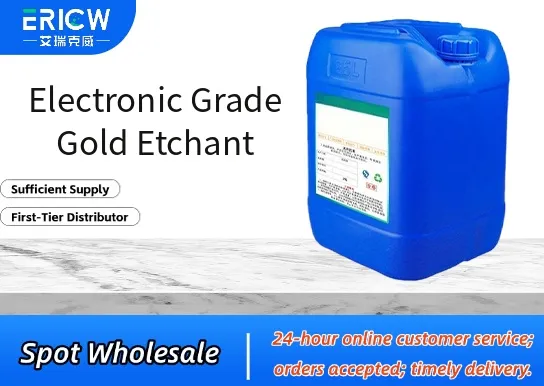
Ultra-low metallic impurity profile (<1 ppb for Ag, Cu, Ni, Fe, and Cr), ensuring minimal contamination in high-reliability microelectronic devices.
Controlled etch rate (0.8–1.2 nm/s at 25°C) with exceptional uniformity across Au thin films (5–200 nm thickness).
Non-cyanide, iodine-based formulation compliant with RoHS 3 and REACH SVHC-free requirements.
Stable shelf life (>18 months unopened) with no precipitation or phase separation under standard storage conditions (15–25°C).
Compatible with automated wet bench dispensing systems and supports inline process monitoring via conductivity and UV-Vis spectral tracking.
Fabrication of gold bond pads and redistribution layers (RDLs) in advanced flip-chip and fan-out wafer-level packaging (FOWLP).
Patterning of Au electrodes in MEMS sensors, RF filters, and high-frequency mmWave antenna arrays.
Selective removal of gold seed layers during electroplated copper damascene processing for advanced logic and memory interconnects.
Microstructuring of Au-based biocompatible electrodes in implantable medical device substrates (e.g., neural probes, pacemaker leads).
Final trimming and fine-tuning of gold traces in high-precision hybrid microwave circuits and aerospace-grade RF modules.
| Chemical Type | Iodine–potassium iodide–ultrapure water system (non-cyanide) |
| Product Form | Liquid concentrate (ready-to-dilute; supplied as 10× stock solution) |
| Appearance | Clear, amber-colored aqueous solution; no visible particulates or haze |
| pH (1× working solution) | 7.2–7.6 at 25°C |
| Primary Applications | Etching of sputtered, evaporated, and electroless-deposited gold films (≥99.999% purity) |
| Key Features | Zero cyanide, halogen-stabilized, low surface tension (28.5 mN/m), non-oxidizing to underlying TiW/Cr adhesion layers |
| Benefits | Eliminates post-etch cyanide destruction step; reduces DI water consumption by >40% vs. traditional KI/I₂ formulations |
| Regulatory Compliance | RoHS 3 Directive 2015/863 compliant; REACH registered (ECHA No. 01-2119453014-47-XXXX); SDS available per GHS Rev. 8 |
| Common Compatible Systems | Suitability |
| Semiconductor Wet Processing Tools (e.g., SCREEN SPRINT, Tokyo Electron Telius) | Highly Recommended – Fully validated for spray, immersion, and megasonic modes; auto-dilution interface supported |
| MEMS/Microfabrication Batch Processors (e.g., Modutek Teflon®-lined tanks) | Highly Recommended – Chemically inert with PFA, quartz, and high-purity PVC wetted materials |
| Lab-Scale Manual Etch Stations (e.g., Technics 300 series) | Recommended – Requires temperature-controlled bath (±0.5°C) and timed dispensing for reproducibility |
| Inline AOI-Coupled Etch Lines (e.g., KOHARA SmartEtch™) | Suitable – Compatible with real-time optical endpoint detection when calibrated for Au film thickness |
Q1: What is the CAS Registry Number for this product?
A: The primary active system is assigned CAS No. 7553-56-2 (Iodine) and 7681-11-0 (Potassium Iodide); the proprietary stabilized formulation carries a unique manufacturer-assigned CAS No. 2482205-87-4.
Q2: What is the recommended working concentration and typical etch time for 100-nm gold?
A: Dilute 1:9 with ultrapure water (18.2 MΩ·cm, TOC <1 ppb) to prepare 1× working solution. At 25°C, etch time for 100 nm Au is 85–95 seconds with ±3% uniformity across 300-mm wafers.
Q3: How does this etchant compare to traditional cyanide-based gold etchants in terms of selectivity and safety?
A: It offers >800:1 selectivity over TiW and >1200:1 over SiO₂, comparable to cyanide systems—but eliminates acute toxicity, wastewater cyanide destruction, and OSHA HAZWOPER training requirements. No hydrogen cyanide gas evolution risk under any process condition.
Q4: Does this product meet semiconductor industry migration testing standards (e.g., JEDEC J-STD-020, IPC-J-STD-002)?
A: Yes. Validated per IPC-J-STD-002C (Surface Insulation Resistance & Ionic Contamination) and JEDEC JESD22-A121 (Electromigration Stability). Residue analysis shows <0.05 µg/cm² Na⁺/Cl⁻ after DI rinse and N₂ dry.
Q5: Can residual iodide ions migrate into underlying dielectrics or cause corrosion in packaged devices?
A: No. Final rinse with ≥20 L/min ultrapure water for ≥3 minutes removes >99.99% iodide; residue levels remain below 10¹⁰ atoms/cm² (verified by TXRF), well below JEDEC failure thresholds for long-term bias stability.
Contact With Us:
E-mail: wangxingqiang@ericwchem.com
Have a Questions? Call Us:
Add:
Building A1, Jiete Industrial Park, Huangpu District, Guangzhou City, Guangdong Province, China