English
 Español
 tiếng việt
 русский
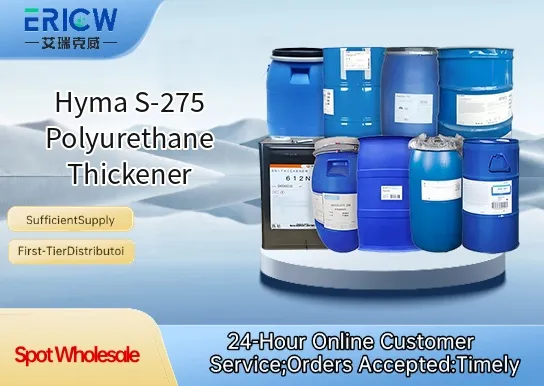
Non-ionic, associative thickener delivering excellent rheology control in waterborne systems.
Provides outstanding sag resistance and leveling balance in architectural and industrial coatings.
Compatible with a broad range of acrylic, styrene-acrylic, and vinyl acetate emulsions.
Low foaming and stable under high-shear mixing conditions.
Enhances brushability and roller application performance without compromising film integrity.
Interior and exterior architectural wall paints.
Waterborne industrial maintenance coatings.
Wood finishes and clear varnishes.
Tile grouts and cementitious waterproofing slurries.
Textile printing pastes requiring viscosity stability.
| Chemical Type | Non-ionic associative polyurethane |
| Product Form | Clear to slightly hazy liquid |
| Appearance | Light amber, homogeneous liquid |
| pH (1% aqueous solution) | 6.0–7.5 |
| Solids Content | 25–27 wt% |
| Viscosity (Brookfield RVT, spindle #3, 20 rpm, 25°C) | 1,500–3,500 cP |
| Primary Applications | Rheology modifier for waterborne coatings and construction chemicals |
| Storage Stability | ≥12 months at 5–30°C in sealed container |
Q1: What type of rheology does Hyma S-275 provide in waterborne systems?
A: Hyma S-275 is a non-ionic polyurethane associative thickener that delivers strong pseudoplastic (shear-thinning) behavior, offering excellent flow and leveling at low shear while providing robust sag resistance and brush/roller drag control at rest and high shear.
Q2: Is Hyma S-275 compatible with common co-thickeners and additives used in architectural coatings?
A: Yes — Hyma S-275 is generally compatible with cellulosic thickeners, acrylic associates, and most standard surfactants, defoamers, and biocides. However, compatibility should always be verified in the final formulation due to potential interactions with high levels of ionic surfactants or certain hydrophobically modified polymers.
Q3: How should Hyma S-275 be incorporated into a waterborne coating formulation?
A: It is recommended to pre-dilute Hyma S-275 with water or a compatible solvent (e.g., glycol ether) before addition, followed by slow incorporation under moderate agitation. Post-addition mixing should continue until full viscosity development is achieved, typically within minutes to an hour depending on formulation pH and temperature.
Q4: Does Hyma S-275 require pH adjustment for optimal performance?
A: Unlike many acid-sensitive thickeners, Hyma S-275 performs effectively across a broad pH range (typically pH 6–10) without requiring strict pH control. However, extreme pH values (<5 or >11) may affect long-term stability and should be avoided.
Q5: Can Hyma S-275 be used in high-solids or low-VOC formulations?
A: Yes — Hyma S-275 is well-suited for low-VOC and high-solids systems due to its solvent-free, water-based nature and efficient thickening at low use levels, supporting formulators in meeting stringent environmental and regulatory targets without compromising rheological performance.
Contact With Us:
E-mail: wangxingqiang@ericwchem.com
Have a Questions? Call Us:
Add:
Building A1, Jiete Industrial Park, Huangpu District, Guangzhou City, Guangdong Province, China