English
 Español
 tiếng việt
 русский
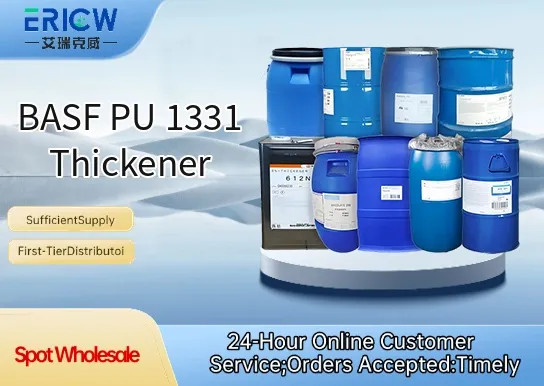
Non-ionic polyurethane rheology modifier delivering efficient thickening in waterborne systems.
Provides excellent sag resistance and anti-drip performance in vertical applications.
Offers outstanding compatibility with acrylic, styrene-acrylic, and vinyl acetate-based dispersions.
Delivers low-shear viscosity enhancement while maintaining good flow and leveling properties.
Stable under freeze-thaw cycling and compatible with common co-solvents and surfactants.
Architectural interior and exterior paints.
Wood coatings including stains and clear finishes.
Industrial maintenance coatings for metal and concrete substrates.
Waterborne primers and sealers.
Decorative plasters and textured wall finishes.
| Chemical Type | Non-ionic polyurethane associative thickener |
| Product Form | Liquid dispersion |
| Appearance | Opaque white to off-white viscous liquid |
| pH (1% aqueous solution) | 7.0 – 8.5 |
| Solids Content | 28 – 32 wt% |
| Viscosity (Brookfield RVT, spindle #3, 20 rpm, 25°C) | 15,000 – 30,000 mPa·s |
| Primary Applications | Waterborne architectural and industrial coatings |
| Key Features | Associative thickening, low VOC, shear-thinning behavior |
Q1: What type of rheology modifier is BASF PU 1331 Thickener?
A: BASF PU 1331 Thickener is a hydrophobically modified polyurethane (HEUR) associative thickener designed to provide efficient viscosity build and excellent flow/leveling balance in waterborne systems.
Q2: In which types of formulations is PU 1331 typically used?
A: It is commonly employed in architectural coatings, industrial maintenance paints, and water-based wood finishes where shear-thinning behavior, spatter resistance, and sag resistance are required.
Q3: How does PU 1331 interact with other formulation components?
A: PU 1331 functions via associative mechanisms—its hydrophobic end groups interact with surfactants, latex particles, and other hydrophobes in the system. Compatibility should be verified when used with high levels of low-HLB surfactants or certain co-solvents.
Q4: What is the recommended addition method for optimal performance?
A: It is generally added during the let-down stage, after pigment grinding and under moderate agitation. Pre-dilution with water or compatible co-solvent is advised to ensure uniform dispersion and avoid localized over-thickening.
Q5: Is PU 1331 suitable for low-VOC or zero-VOC formulations?
A: Yes—PU 1331 is solvent-free and contains no APEOs or alkylphenol ethoxylates, making it well-suited for modern low-VOC and regulatory-compliant waterborne coating systems.
Contact With Us:
E-mail: wangxingqiang@ericwchem.com
Have a Questions? Call Us:
Add:
Building A1, Jiete Industrial Park, Huangpu District, Guangzhou City, Guangdong Province, China