English
 Español
 tiếng việt
 русский
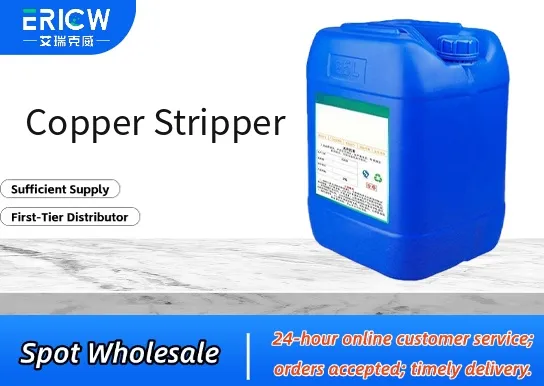
Highly selective removal of copper and copper alloys without attacking underlying substrates such as steel, stainless steel, or nickel.
Non-cyanide, low-corrosivity formulation compliant with modern environmental and workplace safety standards.
Operates effectively at ambient to mildly elevated temperatures (20–45 °C), reducing energy consumption.
Stable bath life with minimal sludge formation; supports extended reuse with simple pH and concentration monitoring.
Rapid stripping kinetics — achieves full copper removal in 1–5 minutes depending on thickness and temperature.
Stripping copper plating from printed circuit board (PCB) panels prior to rework or etching.
Removal of copper flash layers from electroless nickel immersion gold (ENIG) surfaces during PCB defect correction.
Decoppering of misplated or overplated components in semiconductor packaging and leadframe manufacturing.
Preparation of copper-coated tooling and fixtures for recoating or surface restoration.
Recycling and recovery support: selective copper dissolution from mixed-metal scrap streams.
| Chemical Type | Oxidizing acidic blend (sulfuric acid-based with controlled oxidizers) |
| Product Form | Concentrated liquid (ready-to-dilute) |
| Appearance | Clear, light amber to pale yellow solution |
| pH (as supplied) | 1.0–1.8 (25 °C) |
| Primary Applications | Copper stripping from non-copper substrates in electronics and precision metal finishing |
| Key Features | Non-cyanide, low fume emission, substrate-safe, bath-stable |
| Benefits | Reduced hazardous waste disposal burden, OSHA-compliant handling, no hydrogen embrittlement risk |
| Regulatory Compliance | REACH SVHC-free, RoHS 2015/863 compliant, SDS available per GHS Rev. 7 |
| Common Compatible Systems | Suitability |
| Immersion copper removal lines (batch & conveyorized) | Highly Recommended – Designed for seamless integration with standard immersion stripping tanks and rinse sequences |
| Automated spray-type stripping systems | Recommended – Requires nozzle calibration and dwell time optimization; compatible with stainless-steel manifolds |
| Ultrasonic cleaning and stripping units | Suitable – Effective at 25–40 kHz; avoid prolonged exposure above 45 °C to preserve oxidizer stability |
| Waste treatment systems (e.g., precipitation, ion exchange) | Highly Recommended – Generates readily treatable Cu²⁺ effluent; compatible with standard hydroxide coagulation |
Q1: What is the CAS Registry Number for Copper Stripper?
A: This is a proprietary multi-component formulation; individual CAS numbers are assigned only to key constituents (e.g., sulfuric acid: 7664-93-9, sodium persulfate: 7775-27-1). Full composition is disclosed under NDA and on the SDS.
Q2: What is the recommended working concentration and typical immersion time?
A: Dilute 1:4 to 1:9 (v/v) with deionized water. Standard immersion time is 2–4 minutes at 25–35 °C for 0.5–2 µm copper; thicker deposits may require up to 5 minutes or mild agitation.
Q3: How does this Copper Stripper compare to cyanide-based strippers?
A: It eliminates acute toxicity and regulatory restrictions associated with cyanide, offers comparable selectivity and rate for most electronics applications, and avoids mandatory destruction steps — though it is not suitable for stripping copper from zinc or aluminum substrates without inhibition.
Q4: Does Copper Stripper meet IPC-4552A or other industry specifications for ENIG rework?
A: Yes — validated per IPC-4552A Annex B for copper removal prior to re-plating; maintains solderability and intermetallic integrity when followed by proper neutralization and rinsing.
Q5: Is there any risk of copper migration or undercutting during stripping?
A: Under recommended conditions, undercutting is negligible (<1 µm lateral etch) due to controlled oxidation kinetics and surfactant-assisted boundary layer control. Migration is not observed when bath is maintained at pH < 2.0 and free acid is monitored.
Contact With Us:
E-mail: wangxingqiang@ericwchem.com
Have a Questions? Call Us:
Add:
Building A1, Jiete Industrial Park, Huangpu District, Guangzhou City, Guangdong Province, China