English
 Español
 tiếng việt
 русский
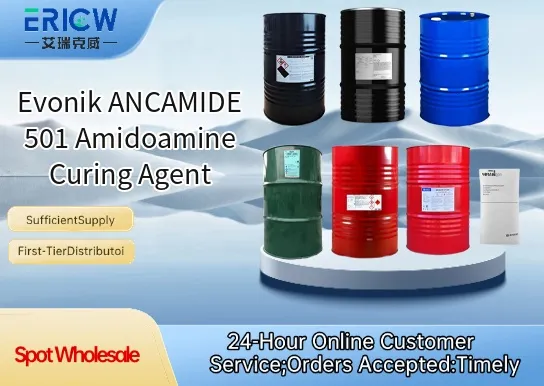
Low-viscosity liquid enables easy handling and efficient mixing with epoxy resins.
Offers excellent flexibility and impact resistance in cured epoxy systems.
Provides good adhesion to diverse substrates including metals, concrete, and composites.
Delivers reduced exotherm during cure—ideal for thick-section or large-part applications.
Compatible with standard bisphenol-A and bisphenol-F epoxy resins without requiring solvents.
Structural adhesives for automotive and transportation assembly.
Coatings for industrial flooring and corrosion protection on steel infrastructure.
Electrical encapsulants and potting compounds for power electronics.
Composite matrix resins in wind turbine blade bonding and repair.
Repair mortars and high-performance grouts in civil engineering.
| Chemical Type | Amidoamine (derived from fatty acids and polyamines) |
| Product Form | Liquid |
| Appearance | Pale yellow to amber transparent liquid |
| Primary Applications | Epoxy resin curing agent for adhesives, coatings, and composites |
| Key Features | Low viscosity, flexible cure, low exotherm, solvent-free |
| Benefits | Improved toughness, substrate adhesion, and processing safety |
| Storage Stability | At least 12 months in original sealed container at 15–25 °C |
| Recommended Mix Ratio (by weight) | Approx. 40–60 phr with standard DGEBA epoxy resins |
Q1: What is the primary function of ANCAMIDE 501 in epoxy systems?
A: ANCAMIDE 501 is an amidoamine-based curing agent designed to react with epoxy resins, enabling crosslinking at ambient or moderately elevated temperatures. It delivers good flexibility, adhesion, and chemical resistance in the cured network, particularly suited for coatings, adhesives, and composite matrices.
Q2: Is ANCAMIDE 501 suitable for low-VOC or high-solids formulations?
A: Yes — ANCAMIDE 501 is a liquid, solvent-free amidoamine with low volatility and no added solvents, making it well-suited for low-VOC and high-solids epoxy formulations where regulatory compliance and environmental performance are priorities.
Q3: How does humidity affect the curing performance of ANCAMIDE 501?
A: As an amidoamine, ANCAMIDE 501 exhibits relatively good moisture tolerance compared to highly reactive aliphatic amines. While excessive humidity may slightly delay surface dryness or cause minor surface blush under certain conditions, it generally maintains robust cure development in typical industrial environments.
Q4: Can ANCAMIDE 501 be used in food-contact or potable water applications?
A: ANCAMIDE 501 is not pre-qualified for direct food-contact or potable water applications. Its suitability for such uses depends on full formulation evaluation, final cured product testing, and compliance with applicable regional regulations — end-users must conduct thorough validation per intended application requirements.
Contact With Us:
E-mail: wangxingqiang@ericwchem.com
Have a Questions? Call Us:
Add:
Building A1, Jiete Industrial Park, Huangpu District, Guangzhou City, Guangdong Province, China