English
 Español
 tiếng việt
 русский
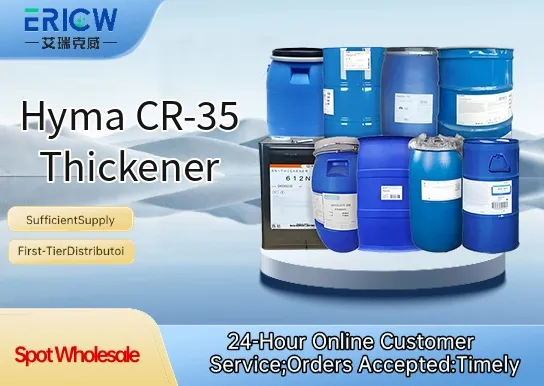
High-efficiency associative thickening with excellent rheology control in water-based systems.
Outstanding compatibility with anionic, nonionic, and amphoteric surfactants.
Provides superior sag resistance and anti-settling performance in high-solid formulations.
Low odor and non-volatile organic compound (VOC)-compliant for eco-friendly applications.
Stable viscosity retention across wide pH range (pH 4–10) and elevated temperatures.
Architectural paints and interior/exterior wall coatings.
Industrial maintenance coatings and protective primers.
Water-based wood stains and clear finishes.
Tile grouts and cementitious waterproofing slurries.
Textile printing pastes and pigment dispersion systems.
| Chemical Type | Hydrophobically modified alkali-swellable emulsion (HASE) |
| Product Form | White to off-white viscous liquid |
| Appearance | Homogeneous, slightly opalescent dispersion |
| Active Content (wt%) | 30.0 ± 1.0% |
| pH (1% aqueous solution) | 3.0 – 4.5 |
| Viscosity (Brookfield RVT, Spindle #3, 20 rpm, 25°C) | 8,000 – 12,000 cP |
| Freeze-Thaw Stability | Pass (3 cycles at –15°C / 25°C) |
| Primary Applications | Water-based architectural and industrial coatings |
Q1: What types of formulations is Hyma CR-35 Thickener most commonly used in?
A: Hyma CR-35 Thickener is widely employed in aqueous-based industrial coatings, architectural paints, printing inks, and waterborne adhesives where controlled rheology and suspension stability are required. It performs especially well in systems demanding non-drip behavior and sag resistance.
Q2: How does Hyma CR-35 differ from conventional associative thickeners?
A: Unlike many hydrophobically modified ethoxylated urethanes (HEURs), Hyma CR-35 offers a balanced combination of high-shear thinning and robust low-shear viscosity build, enabling both sprayability and anti-settling performance without excessive sensitivity to surfactants or co-solvents.
Q3: Is Hyma CR-35 compatible with common biocides and pH adjusters used in water-based systems?
A: Yes — Hyma CR-35 demonstrates good compatibility with standard isothiazolinone and benzisothiazolinone biocides, as well as typical pH adjusters like AMP-95 and TEA. However, it is recommended to conduct compatibility testing within the final formulation due to potential interactions with specific preservative blends or high levels of electrolytes.
Q4: What is the typical dosage range for effective thickening with Hyma CR-35?
A: Dosage depends on formulation requirements, but Hyma CR-35 is typically used at low concentrations — generally ranging from 0.1% to 2% by weight relative to the total formulation — to achieve target viscosity and rheological profile.
Contact With Us:
E-mail: wangxingqiang@ericwchem.com
Have a Questions? Call Us:
Add:
Building A1, Jiete Industrial Park, Huangpu District, Guangzhou City, Guangdong Province, China