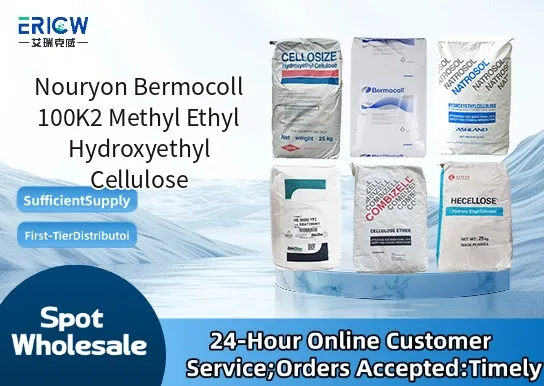
Features Of Nouryon Bermocoll 100K2 Methyl Ethyl Hydroxyethyl Cellulose
Non-ionic, water-soluble polymer with excellent thickening and rheology-modifying performance.
High compatibility with electrolytes, surfactants, and common industrial additives.
Provides outstanding suspension stability and anti-settling properties in aqueous systems.
Delivers consistent viscosity performance across a broad pH range (pH 3–11).
Offers low sensitivity to temperature fluctuations during storage and processing.
Typical Applications Of Nouryon Bermocoll 100K2 Methyl Ethyl Hydroxyethyl Cellulose
Architectural coatings — for improved sag resistance and brush/roller application performance.
Industrial maintenance paints — enhancing pigment suspension and film uniformity.
Tile adhesives and cementitious mortars — contributing to workability and water retention.
Textile printing pastes — enabling sharp pattern definition and stable ink rheology.
Agrochemical formulations — supporting active ingredient suspension and spray stability.
Specifications Of Nouryon Bermocoll 100K2 Methyl Ethyl Hydroxyethyl Cellulose
| Chemical Type | Methyl ethyl hydroxyethyl cellulose (MEHEC) |
| Product Form | Free-flowing white to off-white powder |
| Appearance | Odorless, fine granular powder |
| Primary Applications | Water-based coatings, construction mortars, agrochemicals, textile printing |
| Key Features | Non-ionic, high salt tolerance, excellent film-forming ability |
| Benefits | Improved application properties, enhanced storage stability, reduced formulation complexity |
| pH of 1% Aqueous Solution | 6.0–8.0 |
| Solubility | Readily dispersible and soluble in cold water |
Nouryon Bermocoll 100K2 Methyl Ethyl Hydroxyethyl Cellulose – Frequently Asked Questions (FAQ)
Q1: What is the primary functional role of Bermocoll 100K2 in formulations?
A: Bermocoll 100K2 functions primarily as a rheology modifier and thickener, delivering efficient viscosity development, excellent suspension capability, and improved stability in aqueous systems—particularly where shear-thinning behavior and low-shear viscosity retention are required.
Q2: How does Bermocoll 100K2 differ from standard hydroxyethyl cellulose (HEC) derivatives?
A: The methyl ethyl hydroxyethyl cellulose (MEHEC) structure of Bermocoll 100K2 provides enhanced compatibility with organic solvents and surfactants, broader pH stability, and improved resistance to enzymatic degradation compared to conventional HEC grades—making it especially suitable for challenging industrial and personal care formulations.
Q3: Is Bermocoll 100K2 compatible with common preservatives and electrolytes?
A: Yes, Bermocoll 100K2 demonstrates good compatibility with widely used preservative systems and tolerates moderate levels of electrolytes without significant viscosity loss—though optimal performance should be verified under actual formulation conditions, especially at high salt concentrations or extreme pH.
Q4: What is the typical dosage range for Bermocoll 100K2 in end-use applications?
A: Dosage depends on formulation requirements and desired viscosity profile, but Bermocoll 100K2 is typically used at low concentrations—generally ranging from 0.1% to 2% by weight—in water-based systems such as architectural coatings, cleaning products, and personal care gels.
Q5: Can Bermocoll 100K2 be used in cold-water soluble processes?
A: Yes, Bermocoll 100K2 is designed for easy dispersion and hydration in cold water, minimizing the need for heat-assisted dissolution—supporting energy-efficient manufacturing and simplifying integration into cold-process formulations.
 English
 Español
 tiếng việt
 русский