English
 Español
 tiếng việt
 русский
High thermal stability with continuous service capability up to 200 °C.
Excellent compatibility with vinyl and phenyl-containing polymers and resins.
Low volatility and minimal outgassing under vacuum or elevated temperature conditions.
Enhanced hydrophobicity and surface migration resistance due to phenyl group incorporation.
Reactive vinyl functionality enables covalent bonding in hydrosilylation-cured systems.
Release agent for high-temperature silicone rubber and thermoset composite molding.
Functional additive in LED encapsulants and optical gels requiring UV/thermal stability.
Viscosity modifier and stress-relief component in high-performance RTV and HTV silicone formulations.
Surface treatment agent for silica fillers in specialty elastomer composites.
Base fluid in platinum-catalyzed liquid silicone rubber (LSR) for medical and automotive parts.
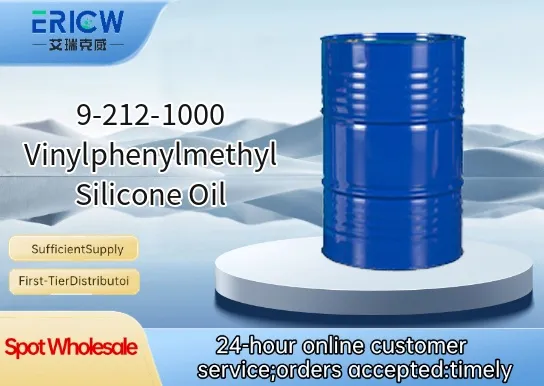
| Chemical Type | Vinylphenylmethyl polysiloxane |
| Product Form | Clear, colorless to pale yellow liquid |
| Appearance | Homogeneous, low-viscosity oil |
| Viscosity (25 °C, cSt) | 1000 ± 150 |
| Specific Gravity (25 °C) | 0.97–0.99 |
| Refractive Index (25 °C) | 1.495–1.505 |
| Vinyl Content (wt%) | 0.12–0.18 |
| Phenyl Content (wt%) | 18–22 |
Q1: What is the primary functional role of 9-212-1000 in silicone-based formulations?
A: 9-212-1000 serves as a reactive vinyl-functional silicone fluid, enabling covalent incorporation into crosslinked silicone networks via hydrosilylation. It enhances flexibility, thermal stability, and interfacial compatibility in cured elastomers, gels, and release coatings.
Q2: How does the phenyl group in this silicone oil influence its performance?
A: The phenyl substituents improve thermal resistance, oxidative stability, and compatibility with aromatic resins or filled polymer systems. They also contribute to reduced surface tension and enhanced adhesion control in specialty coating applications.
Q3: Is 9-212-1000 suitable for use in high-temperature vulcanized (HTV) silicone rubber compounding?
A: Yes — it is commonly used as a processing aid and property modifier in HTV formulations to improve filler dispersion, reduce compound viscosity during mixing, and enhance mechanical resilience after curing.
Q4: Can this material be used in platinum-catalyzed liquid silicone rubber (LSR) systems?
A: Yes — its vinyl functionality makes it fully compatible with Pt-catalyzed hydrosilylation chemistry. It is typically used at low concentrations to tailor modulus, elongation, and surface characteristics without inhibiting cure kinetics when properly formulated.
Q5: What are typical handling and storage recommendations?
A: Store in tightly sealed containers under inert atmosphere (e.g., nitrogen), away from moisture, strong oxidizers, and direct sunlight. Recommended storage temperature is 5–25 °C. Prolonged exposure to ambient humidity or elevated temperatures may affect vinyl reactivity over time.
Contact With Us:
E-mail: wangxingqiang@ericwchem.com
Have a Questions? Call Us:
Add:
Building A1, Jiete Industrial Park, Huangpu District, Guangzhou City, Guangdong Province, China