English
 Español
 tiếng việt
 русский
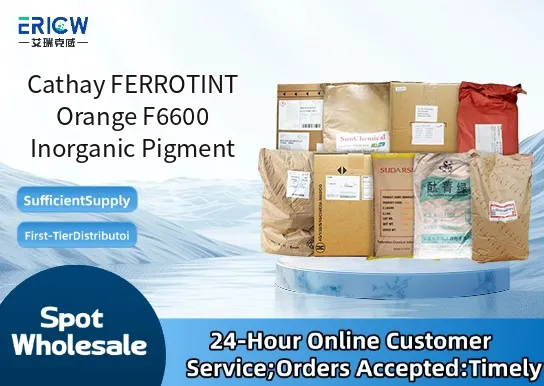
High thermal stability up to 800 °C, suitable for high-temperature ceramic and enamel applications.
Excellent lightfastness and weather resistance, ensuring long-term color retention outdoors.
Non-toxic and heavy-metal-free formulation compliant with global regulatory standards (e.g., EN 71-3, RoHS).
Consistent particle size distribution for superior dispersion and batch-to-batch color reproducibility.
Strong tinting strength and opacity in both aqueous and solvent-based systems.
Ceramic glazes and underglaze decorations for tableware and architectural tiles.
High-performance industrial coatings for automotive and construction equipment.
Plastic coloration for outdoor applications including garden furniture and building profiles.
Specialty inks for heat-transfer printing and ceramic decal transfers.
Fire-resistant intumescent coatings and refractory mortars.
| Chemical Type | Complex mixed-metal oxide (Fe-Zn-Cr spinel) |
| Product Form | Fine dry powder |
| Appearance | Uniform orange-red free-flowing powder |
| Primary Applications | Ceramics, high-temperature coatings, engineering plastics, refractories |
| Key Features | Thermal stability, UV resistance, chemical inertness, low water solubility |
| Benefits | Color consistency, regulatory compliance, processing ease, low dust generation |
| pH (10% aqueous suspension) | 6.5–7.5 |
| LOI (Loss on Ignition, 1000 °C) | ≤ 0.5 wt% |
Q1: What is the primary chemical composition of Cathay FERROTINT Orange F6600?
A: Cathay FERROTINT Orange F6600 is an iron oxide-based inorganic pigment, primarily composed of alpha-iron oxide (α-Fe₂O₃) with controlled crystallinity and particle morphology to deliver consistent orange hue and high thermal stability.
Q2: Is this pigment suitable for high-temperature processing applications such as engineering plastics or powder coatings?
A: Yes — as a thermally stable inorganic oxide, F6600 maintains its color integrity and structural integrity under typical melt-processing conditions up to approximately 350 °C, making it well-suited for polyolefins, polyesters, nylons, and thermoset powder coatings.
Q3: How does F6600 compare to organic orange pigments in terms of weather resistance and lightfastness?
A: Unlike many organic orange pigments, F6600 exhibits excellent inherent lightfastness, UV resistance, and atmospheric stability due to its inorganic nature — it shows minimal fading or chalking even after prolonged outdoor exposure, without requiring additional UV stabilizers in most formulations.
Q4: Can F6600 be used in food-contact plastic applications?
A: While iron oxides are widely accepted for indirect food-contact uses, regulatory compliance depends on regional requirements and final formulation. F6600 is manufactured under strict quality controls and is intended for use in compliant systems where permitted by applicable food-contact regulations — end-use validation is required.
Q5: What is the typical dosage range when incorporating F6600 into polymer systems?
A: Dosage is formulation-dependent but generally ranges from 0.1% to 2% by weight, depending on the desired opacity, chroma intensity, and base resin transparency. It is typically used at low concentrations due to its high tinting strength and efficient dispersion characteristics.
Contact With Us:
E-mail: wangxingqiang@ericwchem.com
Have a Questions? Call Us:
Add:
Building A1, Jiete Industrial Park, Huangpu District, Guangzhou City, Guangdong Province, China