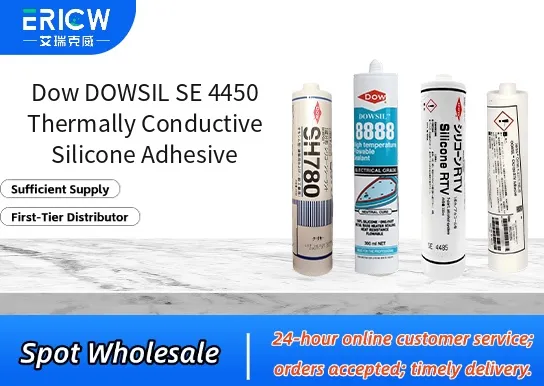
Features Of Dow DOWSIL SE 4450 Thermally Conductive Silicone Adhesive
High thermal conductivity (1.5 W/m·K) for efficient heat dissipation in demanding electronic assemblies.
Low modulus silicone formulation provides excellent stress relief and long-term reliability under thermal cycling.
Room-temperature vulcanizing (RTV) system with rapid tack-free time and full cure within 24 hours at ambient conditions.
Excellent adhesion to diverse substrates including aluminum, copper, stainless steel, ceramics, and common PCB laminates.
UL 94 V-0 rated for flame resistance and compliant with RoHS and REACH directives.
Typical Applications Of Dow DOWSIL SE 4450 Thermally Conductive Silicone Adhesive
Thermal interface bonding of power modules, IGBTs, and MOSFETs to heat sinks in electric vehicle inverters.
Die-attach and heat-spreader attachment in high-power LED lighting systems.
Encapsulation and thermal management of sensors and control units in automotive under-hood environments.
Structural thermal bonding of battery module components in energy storage systems.
Specifications Of Dow DOWSIL SE 4450 Thermally Conductive Silicone Adhesive
| Chemical Type | Platinum-cured addition-cure silicone elastomer |
| Product Form | Two-component (Part A + Part B), paste-like consistency |
| Appearance | Off-white to light gray, homogeneous paste |
| Primary Applications | Thermal interface material (TIM), structural thermal adhesive, die-attach |
| Key Features | Thermally conductive, electrically insulating, low modulus, RTV cure |
| Benefits | Reduces interfacial thermal resistance, accommodates CTE mismatch, enables automated dispensing |
| Cure System | Addition-cure (platinum catalyst); no by-products |
| Storage Stability | 12 months at ≤25°C in unopened containers |
Dow DOWSIL SE 4450 Thermally Conductive Silicone Adhesive – Frequently Asked Questions (FAQ)
Q1: What are the primary application methods for DOWSIL SE 4450?
A: DOWSIL SE 4450 is typically applied via dispensing equipment—such as time-pressure or volumetric systems—for precise placement in thermal interface applications. It can also be screen-printed or stencil-applied depending on part geometry and production requirements.
Q2: How does this adhesive cure, and what are typical cure conditions?
A: DOWSIL SE 4450 cures at room temperature through moisture-cure chemistry, with full property development occurring over several days. Elevated temperatures (e.g., 60–80 °C) significantly accelerate cure speed and improve throughput, though exact timing depends on thickness, humidity, and substrate permeability.
Q3: Is DOWSIL SE 4450 suitable for bonding dissimilar substrates like aluminum, copper, and plastics?
A: Yes—it provides reliable adhesion to a broad range of substrates including metals (aluminum, copper, stainless steel), ceramics, and many engineering plastics, without requiring primers in most cases. Performance may vary depending on surface cleanliness and energy, so standard cleaning and optional plasma treatment are recommended for critical assemblies.
Q4: Can this adhesive withstand thermal cycling and long-term exposure to elevated temperatures?
A: Yes—DOWSIL SE 4450 maintains mechanical integrity and thermal performance across repeated thermal cycles and continuous service at temperatures up to approximately 200 °C. Its silicone backbone delivers excellent resistance to thermal aging, compression set, and environmental stress cracking.
 English
 Español
 tiếng việt
 русский