English
 Español
 tiếng việt
 русский
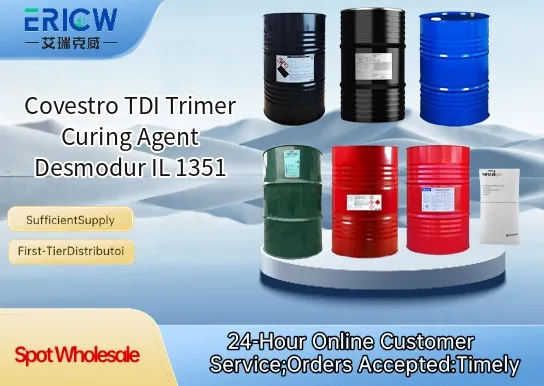
Low-viscosity liquid trimer based on toluene diisocyanate (TDI), enabling easy handling and homogeneous mixing with polyol components.
Excellent compatibility with polyester and polyether polyols, supporting broad formulation flexibility in two-component polyurethane systems.
Provides fast room-temperature cure kinetics without requiring elevated oven temperatures, enhancing production efficiency.
Delivers high chemical resistance and mechanical durability in cured films and coatings, including resistance to solvents and abrasion.
Stable shelf life under recommended storage conditions, with low volatility and controlled NCO content for consistent processing.
Industrial maintenance coatings for metal substrates requiring corrosion protection and rapid return-to-service.
High-performance floor coatings in commercial and industrial facilities demanding abrasion resistance and chemical resilience.
Automotive refinish clearcoats and basecoat/clearcoat systems where gloss retention and weather stability are critical.
Plastic and elastomer coatings for automotive trim, electronics housings, and consumer goods.
Two-component polyurethane adhesives and sealants used in construction and transportation bonding applications.
| Chemical Type | TDI-based isocyanurate trimer |
| Product Form | Liquid |
| Appearance | Clear to pale yellow liquid |
| NCO Content (wt %) | 13.0–14.0 |
| Viscosity at 25 °C (mPa·s) | 800–1,200 |
| Density at 20 °C (g/cm³) | 1.18–1.22 |
| Storage Stability (unopened, 25 °C) | ≥12 months |
| Primary Applications | 2K PU coatings, adhesives, and sealants |
Q1: What is the primary function of Desmodur IL 1351 in coating and adhesive formulations?
A: Desmodur IL 1351 is a low-viscosity, aliphatic TDI-based trimer that serves as a reactive curing agent for hydroxyl-terminated resins—especially polyesters, polyethers, and acrylic polyols. It enables ambient or low-bake crosslinking to deliver durable, chemically resistant films with good flexibility and gloss retention.
Q2: How does Desmodur IL 1351 compare to aromatic isocyanate trimers in terms of yellowing resistance?
A: As a TDI-derived trimer with predominantly aromatic character, Desmodur IL 1351 offers improved UV stability over monomeric TDI but is not classified as non-yellowing. For applications demanding long-term color stability under UV exposure, aliphatic isocyanate trimers (e.g., HDI or IPDI-based) are generally preferred.
Q3: Is Desmodur IL 1351 suitable for moisture-cure systems?
A: No—Desmodur IL 1351 is designed for two-component (2K) systems where it reacts selectively with hydroxyl groups. It is not formulated for ambient moisture cure and requires careful stoichiometric blending with compatible polyols and appropriate catalysts for optimal film formation.
Q4: What storage conditions are recommended to maintain product stability?
A: Store in tightly sealed original containers under dry, cool conditions (typically below 30 °C) and protect from moisture, heat, and direct sunlight. Prolonged exposure to humidity may lead to gelation or viscosity increase due to unintended reaction with ambient water.
Contact With Us:
E-mail: wangxingqiang@ericwchem.com
Have a Questions? Call Us:
Add:
Building A1, Jiete Industrial Park, Huangpu District, Guangzhou City, Guangdong Province, China