English
 Español
 tiếng việt
 русский
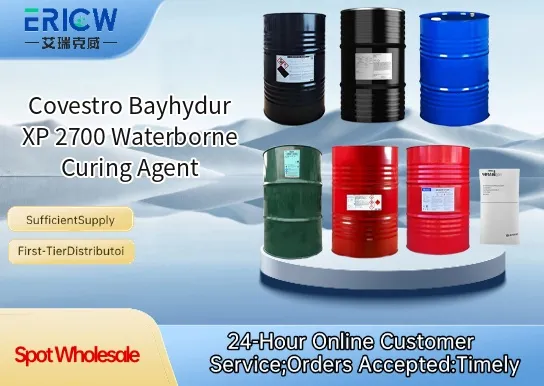
High-performance aliphatic polyisocyanate dispersion with excellent hydrolytic stability.
Low VOC formulation compliant with stringent global environmental regulations.
Enables fast ambient-cure and low-bake performance in waterborne coating systems.
Delivers outstanding gloss retention, color stability, and UV resistance.
Compatible with a broad range of waterborne acrylic and polyester dispersions.
Automotive OEM and refinish clearcoats.
Industrial maintenance and protective coatings.
Wood finishing coatings for furniture and cabinetry.
Plastic coatings for automotive interior parts.
General-purpose high-durability waterborne topcoats.
| Chemical Type | Aliphatic polyisocyanate (HDI-based) dispersion |
| Product Form | Waterborne liquid dispersion |
| Appearance | Clear to slightly hazy, colorless to pale yellow liquid |
| NCO Content (wt. %) | Approx. 7.5–8.2% |
| pH (at 20 °C) | 7.0–8.5 |
| Solids Content (wt. %) | 30–33% |
| Viscosity (mPa·s, 23 °C, Brookfield RVT, spindle #3, 10 rpm) | 150–400 |
| Storage Stability | ≥6 months at 5–30 °C in original sealed container |
Q1: What is the primary chemical composition of Bayhydur XP 2700?
A: Bayhydur XP 2700 is an aliphatic polyisocyanate crosslinker based on hexamethylene diisocyanate (HDI) trimer chemistry, specifically formulated as a water-dispersible, non-ionic dispersion for use in aqueous two-component polyurethane systems.
Q2: How does Bayhydur XP 2700 differ from solvent-borne HDI isocyanates in terms of application performance?
A: As a waterborne curing agent, Bayhydur XP 2700 enables low-VOC formulations while maintaining good pot life, film formation, and final coating properties such as hardness, flexibility, and chemical resistance—though optimal performance requires careful formulation balance with compatible waterborne polyols and proper mixing protocols.
Q3: What are the recommended storage conditions to maintain stability?
A: Store in original sealed containers at temperatures between 5 °C and 30 °C, protected from frost and direct sunlight. Avoid prolonged exposure to high humidity or freezing conditions, which may affect dispersion integrity and reactivity.
Q4: Can Bayhydur XP 2700 be used in food-contact or indoor air-sensitive applications?
A: When fully cured in properly engineered coatings, it contributes to low-emission systems suitable for interior architectural and certain industrial coatings. However, compliance with specific food-contact or indoor air quality regulations depends on the complete formulation and must be verified by the formulator through appropriate testing and regulatory assessment.
Q5: What compatibility considerations should be taken into account when selecting polyol resins?
A: Bayhydur XP 2700 performs best with waterborne acrylic, polyester, or polyether polyols designed for ambient or low-bake curing. Successful formulation requires matching hydrophilic/hydrophobic balance, pH compatibility, and particle size distribution to ensure stable mixing and uniform crosslinking without coagulation or viscosity instability.
Contact With Us:
E-mail: wangxingqiang@ericwchem.com
Have a Questions? Call Us:
Add:
Building A1, Jiete Industrial Park, Huangpu District, Guangzhou City, Guangdong Province, China