English
 Español
 tiếng việt
 русский
Broad-spectrum fungicidal activity against key spoilage microorganisms, including yeasts, molds, and bacteria.
Highly effective at low use concentrations, supporting cost-efficient preservation in water-based formulations.
Excellent stability across a wide pH range (pH 4–10), ensuring compatibility with diverse industrial chemistries.
Non-volatile and non-oxidizing, minimizing impact on product odor, color, and performance integrity.
Regulatory support for global use, including compliance with major international biocidal product frameworks.
Latex paints and architectural coatings
Adhesives and sealants
Industrial metalworking fluids
Construction chemicals (e.g., tile grouts, cementitious slurries)
Water-based inks and pigment dispersions
| Chemical Type | Isothiazolinone-based biocide (mixture of 1,2-benzisothiazol-3(2H)-one and 5-chloro-2-methyl-4-isothiazolin-3-one) |
| Product Form | Aqueous liquid concentrate |
| Appearance | Clear, pale yellow to amber liquid |
| pH (1% aqueous solution) | 2.5–4.5 |
| Density (at 20°C) | 1.08–1.12 g/cm³ |
| Solubility | Miscible with water and common polar organic solvents |
| Primary Applications | Preservation of water-based industrial and consumer products |
| Key Features | Fast-acting, residual protection, low mammalian toxicity profile |
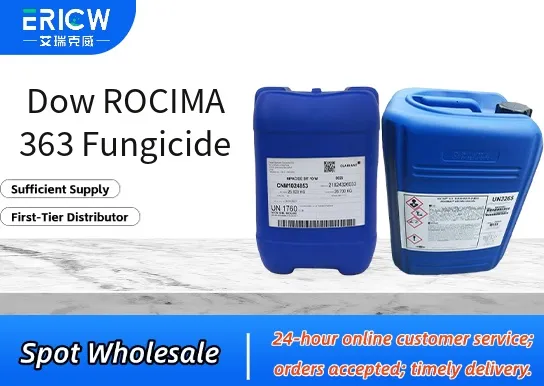
Q1: What is the primary mode of action of Dow ROCIMA 363 Fungicide?
A: Dow ROCIMA 363 Fungicide functions as a broad-spectrum preservative with fungistatic and bacteriostatic activity, primarily inhibiting microbial growth through interference with essential cellular processes in susceptible organisms.
Q2: In which types of industrial formulations is ROCIMA 363 typically used?
A: It is commonly incorporated into water-based industrial products such as metalworking fluids, latex paints, adhesives, construction chemicals, and cleaning concentrates—where long-term protection against spoilage by fungi, yeasts, and bacteria is required.
Q3: Is ROCIMA 363 compatible with common biocide systems used in industrial applications?
A: Yes, ROCIMA 363 generally exhibits good compatibility with other preservatives—including isothiazolinones and formaldehyde releasers—enabling synergistic or complementary use in multi-component preservation strategies, subject to formulation-specific testing.
Q4: How should ROCIMA 363 be handled and stored to maintain its efficacy?
A: Store in original sealed containers at temperatures between 5 °C and 30 °C, away from direct sunlight and strong oxidizing agents. Avoid prolonged exposure to extreme heat or freezing conditions, as these may affect physical stability and performance over time.
Q5: What regulatory considerations apply to ROCIMA 363 in global markets?
A: ROCIMA 363 is registered or approved for use in multiple regions including the United States, Canada, and several countries in Asia and Latin America. Regulatory status varies by jurisdiction and end-use application; users must verify compliance with local biocidal product regulations and notify relevant authorities where required.
Contact With Us:
E-mail: wangxingqiang@ericwchem.com
Have a Questions? Call Us:
Add:
Building A1, Jiete Industrial Park, Huangpu District, Guangzhou City, Guangdong Province, China