English
 Español
 tiếng việt
 русский
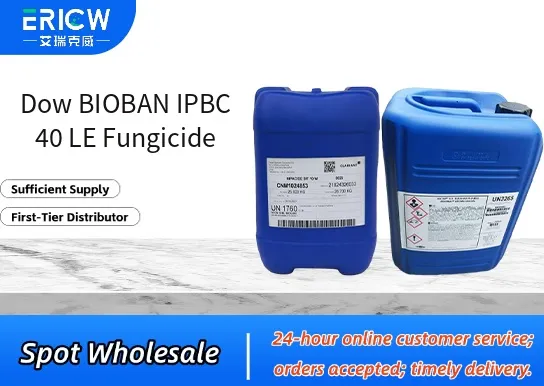
Highly effective broad-spectrum fungicide based on 3-iodo-2-propynyl butylcarbamate (IPBC), offering reliable control against molds, yeasts, and bacteria.
Low-volatility liquid emulsion formulation (40% active ingredient) with excellent stability in aqueous systems across a wide pH range (pH 4–10).
Non-oxidizing chemistry—compatible with common preservatives, surfactants, and thickeners in complex industrial formulations.
Low mammalian toxicity profile and favorable environmental fate characteristics, supporting sustainable product stewardship.
Easily incorporated into water-based systems without phase separation or precipitation issues under standard processing conditions.
Latex paints and architectural coatings for long-term in-can and dry-film preservation.
Water-based adhesives and sealants to prevent microbial degradation during storage and service life.
Construction chemicals including grouts, mortars, and cementitious slurries requiring extended shelf-life stability.
Industrial maintenance coatings and protective finishes exposed to humid or tropical environments.
Nonwoven fabric treatments and paper coatings where mold resistance is critical for packaging and hygiene applications.
| Chemical Type | 3-Iodo-2-propynyl butylcarbamate (IPBC) |
| Product Form | Stable aqueous emulsion |
| Active Ingredient Content | 40.0 ± 1.0 wt% |
| Appearance | Opaque white to off-white liquid |
| pH (1% aqueous solution) | 6.0 – 8.5 |
| Density (20°C) | 1.02 – 1.06 g/cm³ |
| Viscosity (25°C) | 50 – 150 mPa·s |
| Primary Applications | In-can preservation for water-based coatings, adhesives, construction chemicals, and nonwovens |
Q1: What is the primary mode of action of Dow BIOBAN IPBC 40 LE?
A: Dow BIOBAN IPBC 40 LE functions as a broad-spectrum fungistatic and bacteriostatic agent. Its active ingredient, iodopropynyl butylcarbamate (IPBC), disrupts cellular metabolism and inhibits essential enzymatic activity in microorganisms, effectively preventing mold, yeast, and bacterial growth in formulated products.
Q2: In which types of formulations is Dow BIOBAN IPBC 40 LE typically used?
A: This product is widely employed in water-based industrial coatings, adhesives, sealants, construction materials, and architectural paints—especially where long-term dry-film protection against fungal colonization is required. It is also suitable for use in certain non-food-contact polymer systems and maintenance-grade protective coatings.
Q3: How does the “LE” (Low Emulsifier) version differ from standard IPBC formulations?
A: The LE grade features a reduced emulsifier content, resulting in lower foam generation, improved compatibility with sensitive surfactant systems, and enhanced stability in low-VOC or high-solids formulations. This makes it particularly advantageous for modern, environmentally driven coating and adhesive systems where formulation clarity and rheological behavior are critical.
Q4: Is Dow BIOBAN IPBC 40 LE compatible with common biocide boosters or co-biocides?
A: Yes, it demonstrates good compatibility with several complementary preservatives—including isothiazolinones and benzisothiazolinone—enabling synergistic performance in multi-microbe challenge scenarios. However, compatibility testing under actual formulation conditions is recommended prior to full-scale implementation.
Contact With Us:
E-mail: wangxingqiang@ericwchem.com
Have a Questions? Call Us:
Add:
Building A1, Jiete Industrial Park, Huangpu District, Guangzhou City, Guangdong Province, China