English
 Español
 tiếng việt
 русский
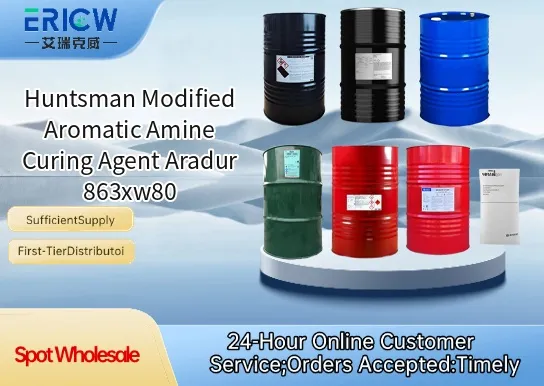
Low-viscosity liquid formulation enabling easy handling and homogeneous mixing with epoxy resins.
Modified aromatic amine chemistry delivering enhanced thermal stability and reduced exotherm versus standard DDM-type hardeners.
Improved compatibility with bisphenol-A and bisphenol-F epoxy systems without phase separation.
Reduced volatility and lower skin sensitization potential compared to conventional aromatic amines.
Enables room-temperature cure with good through-cure performance and post-cure flexibility.
Structural adhesives for aerospace and transportation bonding.
High-performance composite matrices in wind turbine blades and sporting goods.
Electrical encapsulation and potting compounds requiring low shrinkage and high dielectric strength.
Industrial flooring and protective coatings demanding chemical resistance and rapid return-to-service.
Repair mortars and grouts where controlled reactivity and extended working time are critical.
| Chemical Type | Modified aromatic amine |
| Product Form | Liquid |
| Appearance | Clear, pale yellow liquid |
| Primary Applications | Epoxy resin curing agent for structural composites, adhesives, and coatings |
| Key Features | Low viscosity, reduced toxicity profile, balanced reactivity |
| Benefits | Improved processability, enhanced thermal and mechanical performance, safer handling |
| Storage Stability | 12 months at 25°C in original sealed container |
| Reactivity Profile | Medium-reactive; suitable for RT cure with optional post-cure |
Q1: What is the primary function of Aradur 863xw80 in epoxy systems?
A: Aradur 863xw80 is a modified aromatic amine curing agent designed to provide enhanced reactivity, improved chemical resistance, and reduced exotherm compared to conventional aromatic amines—making it suitable for demanding structural adhesives, composites, and high-performance coatings.
Q2: How does Aradur 863xw80 compare to standard DDM or m-PDA in terms of handling and safety?
A: As a modified aromatic amine, Aradur 863xw80 offers lower volatility and reduced skin sensitization potential relative to unmodified aromatic diamines like DDM or m-PDA. It remains an amine compound requiring appropriate PPE and ventilation during handling, but its formulation enhances workplace safety profile.
Q3: Is Aradur 863xw80 compatible with liquid epoxy resins such as DGEBA?
A: Yes, Aradur 863xw80 is fully compatible with standard bisphenol-A based liquid epoxy resins (e.g., DGEBA), as well as solid and novolac epoxies. It typically cures at ambient to moderate elevated temperatures (20–80 °C), depending on the desired performance balance.
Q4: What are typical processing advantages when using Aradur 863xw80 in composite manufacturing?
A: Its tailored reactivity profile supports extended pot life at room temperature while enabling rapid development of mechanical properties upon heating—beneficial for resin transfer molding (RTM), vacuum-assisted resin infusion (VARI), and prepreg applications where controlled gel time and low exotherm are critical.
Contact With Us:
E-mail: wangxingqiang@ericwchem.com
Have a Questions? Call Us:
Add:
Building A1, Jiete Industrial Park, Huangpu District, Guangzhou City, Guangdong Province, China