English
 Español
 tiếng việt
 русский
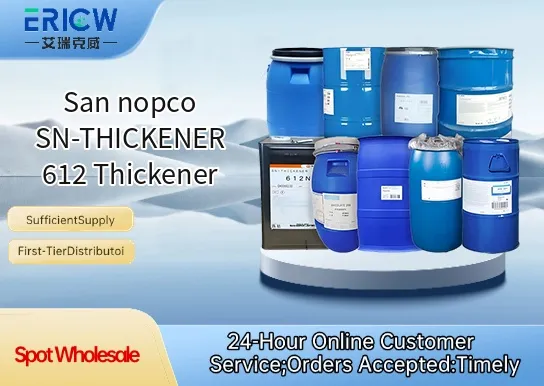
High-efficiency associative thickening for stable rheology control in water-based systems.
Excellent compatibility with anionic, nonionic, and amphoteric surfactants.
Low-foaming performance ideal for high-shear industrial cleaning and coating formulations.
Enhanced suspension stability for pigments and fillers in architectural and industrial paints.
pH-stable across broad range (pH 4–12), supporting formulation flexibility without viscosity drift.
Architectural interior and exterior latex paints.
Industrial maintenance coatings and coil coatings.
Heavy-duty liquid detergents and institutional cleaners.
Water-based adhesives and construction sealants.
Textile printing pastes and pigment dispersions.
| Chemical Type | Hydrophobically modified alkali-swellable emulsion (HASE) |
| Product Form | Aqueous dispersion |
| Appearance | Opaque white to off-white viscous liquid |
| Active Content | 30.0 ± 1.5 wt% |
| pH (1% aqueous solution) | 3.0 – 5.0 |
| Specific Gravity (25°C) | 1.02 – 1.06 g/cm³ |
| Viscosity (Brookfield RVT, spindle #3, 20 rpm, 25°C) | 8,000 – 12,000 cP |
| Primary Applications | Water-based paints, coatings, cleaners, adhesives |
Q1: What types of formulations is SN-THICKENER 612 typically used in?
A: SN-THICKENER 612 is commonly employed in water-based industrial coatings, architectural paints, adhesives, and construction mortars where controlled rheology and improved sag resistance are required. It is especially valued in systems demanding low-shear viscosity build and good high-shear flow.
Q2: How is SN-THICKENER 612 incorporated into a formulation?
A: It is generally added during the let-down or post-addition stage under moderate agitation. Pre-dispersing in water or co-solvent prior to incorporation helps ensure uniform distribution and optimal thickening performance. Avoid high-shear dispersion at elevated temperatures unless validated for the specific system.
Q3: Does SN-THICKENER 612 affect film formation or drying behavior?
A: As a non-ionic associative thickener, it typically has minimal impact on film formation kinetics or final film integrity when used within recommended dosage ranges. However, excessive addition may influence coalescence or surface appearance, so dosage should be optimized per formulation.
Q4: Is SN-THICKENER 612 compatible with common biocides and surfactants?
A: Yes — it demonstrates broad compatibility with standard isothiazolinone and benzisothiazoline biocides, as well as anionic, non-ionic, and amphoteric surfactants typically found in architectural and industrial coatings. Compatibility testing is still recommended for new or highly specialized additive packages.
Q5: What is the typical dosage range for effective viscosity control?
A: Effective dosage generally ranges from 0.1% to 2.0% by weight of the total formulation, depending on the desired viscosity profile, pigment loading, and presence of other rheology modifiers. It is typically used at low concentrations to achieve efficient thickening without compromising application properties.
Contact With Us:
E-mail: wangxingqiang@ericwchem.com
Have a Questions? Call Us:
Add:
Building A1, Jiete Industrial Park, Huangpu District, Guangzhou City, Guangdong Province, China